
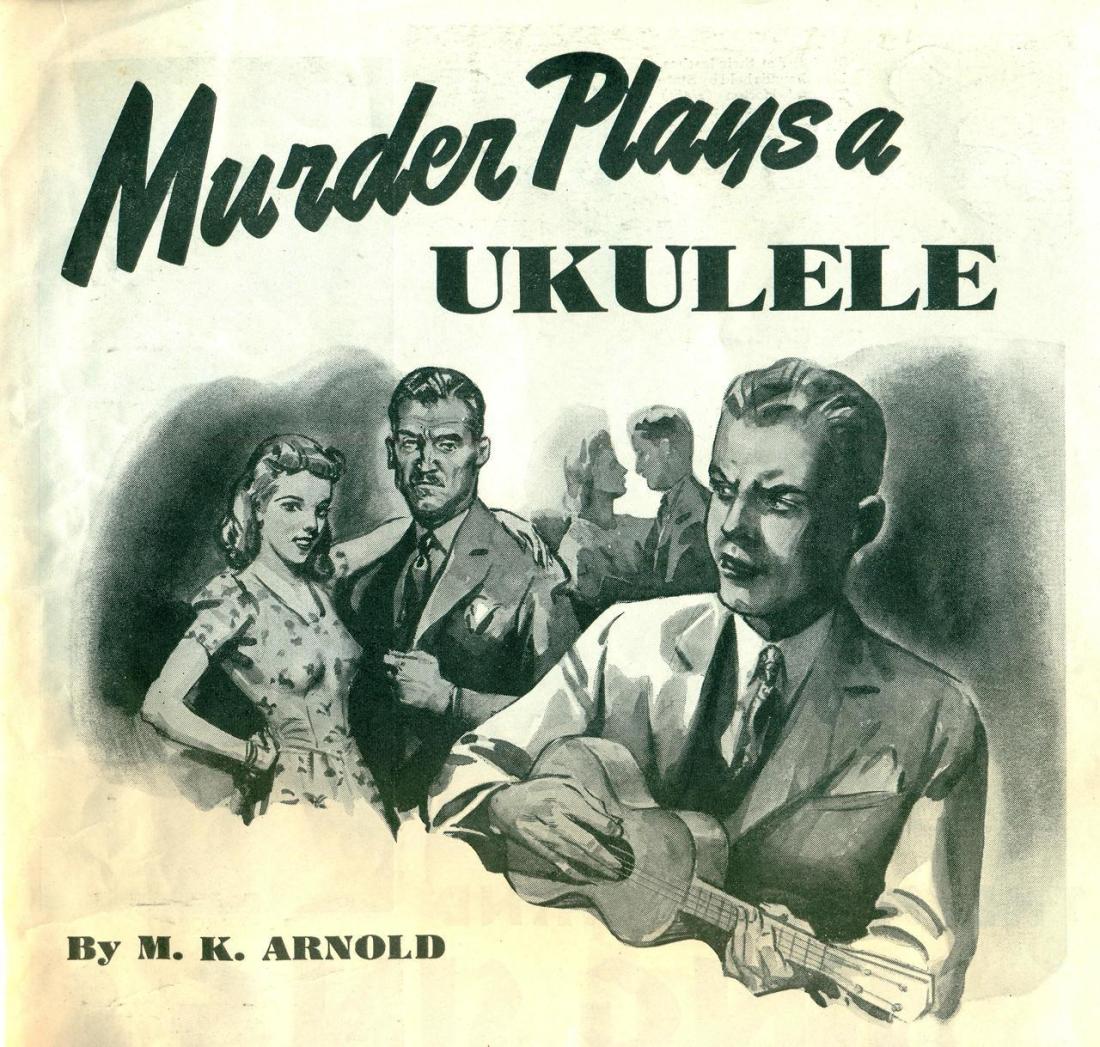
Reposting this art because a) the OP didn’t own it anyway and b) I didn’t want to spam them….
@wehaveallgotknives requested a liveblog of my reading of Murder Plays A Ukulele by MK Arnold, published in the July 1941 issue of Master Detective Magazine. You can read the saga of my interest in the magazine here, including a search that it turns out went ALL THE WAY to the LIBRARY OF CONGRESS, which is where the scan of my copy came from.
If you wish to avoid tons of reblogs of this post as I read, block it now or blacklist “murder plays a ukulele”. I have pizza, cherry sprite zero, and murder on my docket for the next hour.
Also I think you all need to know, I didn’t realize, this isn’t fiction. This is the true story of a ukulele-adjacent murder. It opens with a woman discovering a dead man in a field while fetching in her cow for the evening milking….
…..in San Jose, California.
(We’re going to assume the dead man is the one with the mustache.)
The year: 1926
The place: San Jose, California
The victim: Andrew Pashuta, who has died from several blows to the head
The ukulele: not yet in evidence.It appears the hero of the piece may be young Santa Clara County deputy sheriff Ed Hicks, who was so excited to hear that a dead body had been found while he was off shift that they had to stop him from driving to the crime scene and redirect him to the morgue.
These are their stories. *Law & Order bumper noise*
….Ed Hicks opens his investigation by telephoning his ten year old daughter to ask her why the name Andrew Pashuta is so familiar to him.
AND SHE KNOWS THE ANSWER. It’s because he was dating Edith, who used to work as a maid for the Hicks family but who had recently moved to San Francisco (that’s her being cradled lovingly if possessively by the mustachio’d Andy in the picture).
I didn’t even mention this earlier but the tagline of this story is “A ukulele – an abandoned car – and a bicycle on the beach…smart detective work linked them together and nabbed the killer.”
I can’t wait to see how the bicycle on the beach plays into it.
It turns out Andy Pashuta played the ukulele (no surprise) and was seen palling around with a Suspicious Character who also played the ukulele and wore a blue coat, hiking pants, and leather puttees. I always thought puttees were a type of trouser but apparently they are a strap wrapped around the ankle and calf.
“This meager description was promptly wired to Los Angeles police by Sheriff Lyle […] he stated also in the telegram that the wanted man might have two ukuleles in his possession…”
And a little later they confirm the guy who stole Pashuta’s car abandoned it near LA, but “Looking for a ukulele player in Los Angeles was like looking for a needle in a haystack.”
Apparently LA was a hotbed of ukulele activity in the twenties.
@strangeselkie I do not believe Andy Pashuta was bludgeoned to death by one of the two ukuleles but admittedly the ukuleles have not yet been found in the narrative.
Meanwhile, Ed Hicks has been given permission to go to LA to locate the suspicious “Fred Roland” (clearly an alias) and his two incriminating ukuleles. He believes “Fred” may be staying with a woman he knows in Venice, California, referred to as “a near-by beach resort”.
He is armed only with his map, his badge, and his wits, the brave Ed Hicks.
Sidebar: the fourth page of this gripping account of true crime investigation is primarily taken up with an advertisement for the euphemistically named “Internal Baths”.
In fifteen minutes your impacted colon is thoroughly cleansed of its whole foul mess; the puetrefying, delayed waste is loosened and washed away. Often the relief is immense – often a new sense of vigor and well-being sweeps over you.
They do say that most detective work is very boring, and after a lot of evidence of that in the form of asking a lot of questions and not getting much information, Ed Hicks has finally got a hot lead – two LA cops, Christensen and Whaley, recall having seen someone matching the description on a beach earlier that day.
THE BICYCLE APPEARS
OR RATHER DISAPPEARS
It turns out the cops ran a man matching “Fred’s” description off the beach after being told by a young boy that the man had thrown his bicycle into the ocean. The man admitted he threw the bike into the ocean after the boy caught him and a girl canoodling in the sand, and the cops made him go get it out of the ocean again, which is. Just. Wow.
Also he had a ukulele with him which after the brutal slaying of a ukulelist in San Jose is cause for suspicion.
Anyway they are now on their way to pick the guy up, having gotten his address from a cabbie he failed to pay for his ride.
Frank Galloway, our purported murderer, has been found! In his possession are two ukuleles. Why would any man have two ukuleles?
“Well,” he said huskily, “you’ve got me. I wondered how long it would take.”
It turns out Frank Galloway is an ex convict wanted for deserting the army and having absconded with government funds, although his prison term was “on Dyer Act charges.” I was hoping Dyer Act would be something weird and interesting but it’s just car theft legislation.
OH SHIT ALSO
“Why are you making this statement?”
The answer took his hearers by surprise. “Because, by so doing, I hope that I may ask for, and receive, a death sentence!”
Ukulele players. We’re all drama queens, you guys.
(There’s still like 2/3 of a page left so clearly the story doesn’t end here!)
Oh man, this is so anticlimactic. The murder wasn’t over a woman or a debt or even over a ukulele, he just killed Andy Pashuta because he’d told him that he was an ex-convict on the run from the Army and after they got in a fight, Andy threatened to dun him in.
This is the lesson, kids – never tell a ukulele player what your plans are.
It does turn out that Frank Galloway is also the “only black sheep of a prominent and highly respected northern California family.” I guess he’s like. Galloway of the Chico Galloways or something. (Californians will find that funny.)
Stay tuned, there’s still like an entire segment on his activities in prison…
Well, all good stories must come to an end.
The ukulele killer Frank Galloway eventually got life in prison in Folsom for his crime, where he became sports editor of the Folsom prison newspaper and continued to play the ukulele. Presumably this was his own and not the one he stole from Andy Pashuta after murdering him “with the crank of his Chevrolet automobile” which I think means the crank he used to wind up the engine with, this being the 20s.
He got paroled in 1940, and immediately formed a stick-up gang and terrorized Los Angeles for a while until he was recaptured. Presumably this is why the article about him appeared in 1941.
Can you imagine. Like. MK Arnold, bless her, trying to drum up ideas for a true crime story for Master Detective Magazine, stumbles across Frank Galloway’s arrest for robbery and when she asks some cop about he’s like “Oh yeah, he’s the fella got caught in a murder on account of his ukulele twenty years ago”.
MK Arnold: Beg pardon?
Random cop: Buckle in, sister, this is a wild ride.She does take very great care to remind us that Edith, the girlfriend of the murdered man, had nothing to do with his death or the subsequent theft of his ukulele (and car).
So that’s the story, you guys. The privileged scion of the wealthy and erudite Chico Galloways came to a bad end in Folsom Prison – as any Los Angeles ukulele player might. Truly a cautionary tale for the ages.
Did you enjoy this liveblog? Consider a donation to my Ko-Fi or via my Paypal!
WAIT THERE’S MORE
Googling “Andrew Pashuta” turned up some more stuff about the
case – Galloway was originally sentenced to death, but won a retrial and got
imprisonment:
The homicide occurred on the last
night of the Rose Festival at San Jose, Saturday, May 22, 1926, about midnight,
on a road near the highway to Monterey, some four or five miles from San Jose.
On the preceding Thursday appellant and deceased had met for the first time in
St. James Park and became acquainted through their mutual fondness for the
ukulele, which both had and played. They spent Thursday evening, part of
Friday, and Friday and Saturday evenings together. Appellant was at that time
about twenty-four years of age, while Pashuta was a year or so younger. Pashuta
resided in San Jose at the house of Mrs. Ida M. Bunch, 353 South Fourth Street,
and as appellant was only in town for the festival, Pashuta introduced him to
Mrs. Bunch as his friend, and on the fateful evening had asked her permission
for appellant to occupy his room with him that night. The boys went to
Pashuta’s room to dress for the evening and Pashuta asked Mrs. Bunch to come up
and hear appellant play the ukulele, saying: “He can make it talk.”
He also asked if he might defer payment of his rent as he and appellant wished
to have a good little time that evening. The boys left the house in Pashuta’s
automobile, an old Chevrolet roadster, about 8 o’clock. They first purchased
two bottles of “white liquor” and after drinking some of it, drove on
to St. James Park. There they talked with three other boys, two of whom
testified that they drank with both Pashuta and appellant, and one of whom
stated Pashuta and appellant were intoxicated while with him and that they left
about 10:30 P.M., saying they intended to go some other place to make some
money — evidently Chick Leddy’s, a roadhouse. The testimony of the various
witnesses, without conflict, shows that appellant and Pashuta were apparently
very good friends during this entire period, dancing and singing together and
playing their ukuleles.
….
When appellant was arrested in Venice,
California, about two weeks later, he made a written confession, introduced in
evidence by the prosecution, stating his subsequent actions to have been
substantially as follows: While he and Pashuta were parked near the highway, as
above set forth, and while both of them were intoxicated, an argument arose
between them. Appellant stated that about six months previous in a fit of
despondency he had enlisted in the United States army, from which he had
deserted about four months later, after a night of intoxication. This he had
confessed to Pashuta and it was Pashuta’s threat to expose him as a deserter
which led to the final argument culminating in death. “Q. Where were you
at the time this man threatened to turn you in for desertion? A. To the best of
my knowledge, we were seated in his car parked on the Los Angeles highway south
of San Jose. Q. How long a time elapsed between the time he made a threat of
exposure and the time you killed him? A. As I remember, the act was committed
immediately after the voicing of the threat. Q. Did you make up your mind at
the time he made this threat to kill him? A. I was incapable of making up my
mind, but I remember taking up the first thing that came handy and striking at
him. Q. Did you strike more than one blow? A. I did. Q. How many times did you
hit him with this crank? A. I have no recollection of how many times I struck
him, although it was more than once.” The crank used to start the motor
was the weapon used and the autopsy surgeon testified to four wounds on the
head and face, two of them of a most serious and brutal character.
Appellant told substantially the same
story as a witness at the trial. He there stated: “I was terrified at the
thought of exposure, what it would mean to me and to my people, and the awful
disgrace to them. As far as I can remember, at the moment of the threat I lost
control of myself, and picked up the first thing that came handy and struck at
him. Hazily I remember dragging him from the car into a field at the side of
the road. I did not know I had killed him. I returned to the car. After some
confusion, finally, *Page 85 I drove to his
house where I packed his things with my own, to give the impression I had
left.”
After the homicide, appellant dragged
the body of deceased into a field, a distance of about seventy-five feet and,
placing it in an open furrow, partially covered it with two handfuls of dry
grass. He then drove back to San Jose, went to the room of deceased, and took a
suit of clothes, an overcoat, and blanket. His statements from the period when
they left the park were partially corroborated by the physical condition of the
body when found about a week after death, as well as by the blood stains upon
the automobile. Mrs. Bunch testified that the next morning she found the room
of deceased in great disorder, things all over the floor, dirty clothes in the
middle, etc., and that a suit of his clothes were gone and a blanket.
Galloway won a retrial because one of the jurors was
demonstrably out to convict him from the start, because she disapproved of
drinking:
The affidavit of O.B. Brott stated, in
substance, that while driving his automobile in San Jose on September 12, 1926,
Mrs. Finley, Mrs. Pratt, and Mrs. Roberts being with him as guests, said Mrs.
Roberts stated in his presence and hearing, and that of said other persons,
that she would hang anybody that would get drunk.
The affidavit of Mrs. Minnie Hussey
stated, in substance, that on September 15, 1926, she met Mrs. Roberts and
walked with her along South First Street in San Jose; that on that occasion
said Mrs. Roberts stated to her that she had been called as a juror in this
case and further stated: “Well, I have no use for anyone that drinks and
I’d hang him.”
The affidavit of Alice M. Pratt
stated, in substance, that about September 13, 1926, after said Mrs. Roberts
had been *Page 87 summoned as one of the
jurors in this case, but before her examination, said Mrs. Roberts was present
at a ranch of affiant near San Martin; that she stated in the presence of
affiant that she expected to be called on the jury and if so called she would
hang him (referring to appellant); that affiant said, “Oh! Ida, I will
challenge you”; that said Ida M. Roberts answered, “Just try
it”; that thereafter on September 17, 1926, and while said Ida M. Roberts
was a juror in the trial of said case, she held a conversation over the
telephone with affiant and discussed therein the testimony of the witness Mrs.
Bunch; that she related to affiant the testimony given by said witness and
said: “Poor little Andrew Pashuta was a fine boy; and it was a shame that
this Galloway boy (meaning appellant) had taken him out and given him liquor
and started him drinking when he never drank before”; that on Sunday
evening, September 19, 1926, said Ida M. Roberts again had a telephone
conversation with affiant, discussing therein appellant’s testimony and stating
that he was a nice appearing young man and was a nice, smooth talker and very
calm, but that nevertheless he would hang; that on the evening of September 20,
1926, said Ida M. Roberts had another telephone conversation with affiant in
which she stated that the argument of the deputy district attorney was
“wonderful” and “masterful”; that appellant’s attorney had
made some weak sort of argument to try and save his client from the gallows,
but she repeated and repeated that appellant would nevertheless hang; that on
Sunday, September 19, 1926, affiant visited a ranch near Mountain View with
said Ida M. Roberts and while there said Ida M. Roberts told affiant of the
testimony of various witnesses during the trial and, pointing to an irrigation ditch,
said: “That is the kind of a ditch or furrow that the Galloway boy put
little Andrew Pashuta in and put the grass over him”; that affiant
remonstrated with said Ida M. Roberts on several occasions but said Ida M.
Roberts only laughed and shrugged her shoulders and expressed her determination
that appellant should hang; that on the evening of September 21, 1926, said Ida
M. Roberts telephoned affiant that the case was over and the verdict was
hanging, of course; that she further stated three of the jurors held out for a
while but that “we whipped them into line.”
Apparently the case has been cited in 33 subsequent cases,
mostly, I think, as precedent for declaring a mistrial due to juror bias.
https://www.courtlistener.com/opinion/3309664/people-v-galloway/?order_by=dateFiled+desc
 Mooncustafer
