

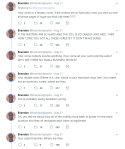


FINALLY 👏 SOMEONE 👏 SAID 👏 IT. 👏 ALL OF IT. 👏ALL AT ONCE. 👏
(Thank you @fallingawkwardly for bringing this to my attention.)
Brandon Taylor is great.
while brandon taylor is p cool, actually stopping to address like half of these would bog your story down in some of the most fantastically pointless, reader unfriendly, and unnecessary detailing ever written since the silmarillion was slapped down on the intake desk at george allen & unwin, and amounts to little more than pedantic nerd-flexing, “how did they agree on a systematised measure of time”? are you KIDDING ME?? more like how the fuck could you possible convince your read that yes, it matters, please don’t go, just another 500 words on my in-universe ‘mathematics in the context of social sciences’ textbook that my illiterate character happened to be thumbing through. it’s important to work on your world building, obviously, but there is a pretty hard limit to what you need to show your reader, and when you cross that line, unless you happen to be the reincarnated soul of terry pratchett, it becomes flabby, boring, and distracting from the actual story. YES to getting rid of senseless misogynistic tropes and putting more effort into crafting your story, NO to including the fucking ancestral migrations of horses.
Nah. It wouldn’t bog the story down, in and of itself. You’re conflating two things: realism of setting with the writer’s ability to pull it off.
Lots of medieval European novels exist that depict the setting in a more realistic manner. They’re not the ones that get Game-of-Thrones popular, because much of the medieval European audience isn’t interested in realism; they want white supremacy and romanticized nobility and women depicted as chattel and so on. They come here for the fantasy of a world where they don’t have to depict Certain Non-White People as complex or interesting, or Certain Genders or Orientations as even existing, and where all problems can be solved by weird eugenics (”he carries the king’s blood, that automatically makes him more noble than the rest of us!”) and violence. But there’s an entire field – historical fiction – where realistic depictions of medieval Europe aren’t just common, they’re expected. Not everybody craves erasure and oversimplification.
But this is an entirely different matter from capability to write realistic medieval Europe. Any writer can do anything if they have the skill to pull it off. But doing this takes more effort than writing lazy, creepily racist settings that reinforce myths rather than facts. Historical fiction writers do research, for example. They don’t just set their last D&D session on paper. And good writers can make a story interesting about any character – not just the princes, or the farmboys destined to become princes, but maybe the egg woman whose protein keeps the village alive through the year without a summer. Maybe the merchant’s son who desperately needs to keep his scorned faith hidden while he’s off being apprenticed to another family. Maybe the traveler from Kathmandu who’s brought a load of goods (and maybe a mortarboard plow) from the East; she speaks ten languages and falls in love with a Saxon farmgirl. Depicting these stories doesn’t require an infodump, just some skill. And interest in doing something other than what’s been done a million times before.
So, okay, maybe you can’t write a medieval story that recognizes your characters won’t be riding any superfast Arabian-style horses called Shadowfax or whatever, because there’s no Arabia and/or your society’s been at war with them for 1000 years, put that mf on a plowhorse and tell him to do his best. But that doesn’t mean a good writer can’t manage it. And don’t pooh-pooh the idea of realism just because you don’t feel like trying it.
 Mooncustafer