
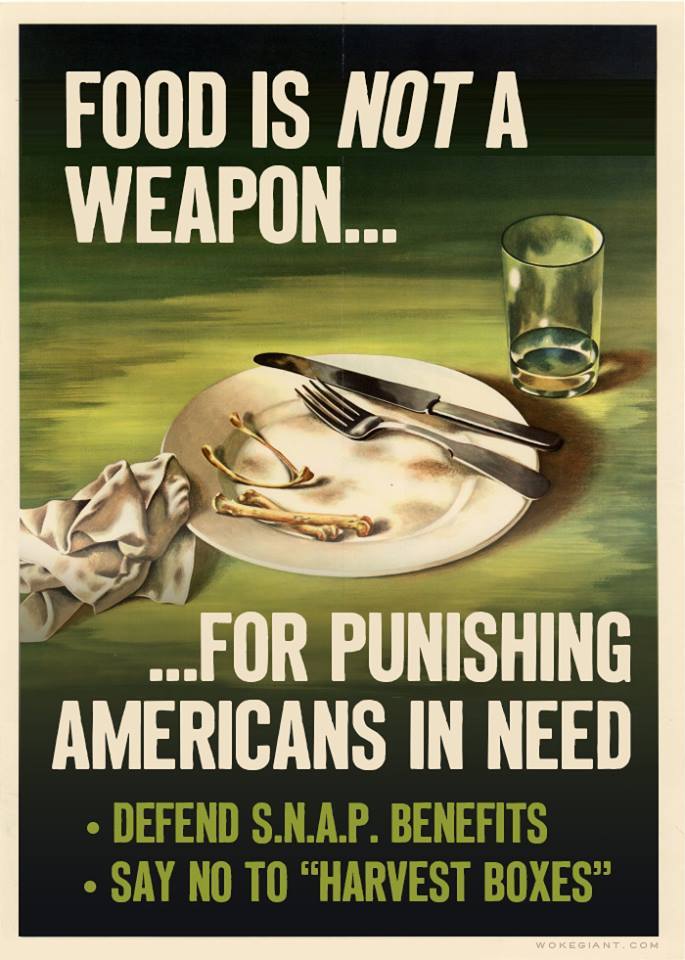
Okay, but how is giving people boxes of actual food turning food into a weapon to hurt people? Btw, I’m speaking as someone who HAD to have food stamps up until a few months ago because I was trying to get back on my feet after my separation from my ex…which FYI was THE most humiliating thing I ever had to do as an adult (besides admitting that yes, I DID voluntarily marry that redneck hillbilly). Truthfully, getting a food box wouldn’t have been any different than getting food stamps because I’d still have been getting food for my kids, and that’s all that mattered.
I think the only people who have a problem with this idea are those who either abuse their benefits (*cough* addicts *cough*) to buy drugs, or the people who just automatically hate everything Donald Trump says just because Donald Trump said it. I bet if Barack Obama wanted food boxes, this would totally be a non-issue. What the fuck does it matter who suggested the idea as long as the people in need get the FOOD they need to survive and feed their families?
Here’s another thing to consider…these food boxes are supposed to reduce the cost of feeding needy people. That means MORE people can get help feeding their families. People that may not have qualified for food stamps before because they made just a little too much money might now be eligible to get some assistance. Did you people ever think of THAT while you were bitching about Trump?
I don’t particularly like the dude, but taking care of our fellow Americans should take precedence over hating on the president.
I’ll admit I haven’t taken the time to look up information about these food boxes, but if what you say is true, then I 100% agree with you.
Some people get so caught up in moral purity, which no human possible can ever live up to, that they care more about the person who presented the idea rather than the idea itself. Then, most ironically, they become the obstacle towards helping the people they claim to care about and that, in turn, can cause some serious damage, depending on the circumstances.
For example – and it’s possible I’ll get a lot of abuse for this, but here goes – if you are of the mindset that you want to end America’s wars, guess who your allies, apart from progressives, far leftists and Tulsi Gabbard, would be?
*drum roll*
The alt-right.
That’s correct, you’d be on the same team as Richard Spencer.
While they come at it from a very different angle than progressives, obviously, the alt-right also wants to put a stop to the endless wars. How is that for a mindfuck?
This, again, shows perfectly well the existence of grey morality, especially in politics. The question then isn’t who presented the idea. It’s how the political landscape will be shaped by future generations. Will they be able to “swallow the camel”, as we say in my language, and accept the truth of grey areas, in order to bring about the solutions needed, or will they become the very thing that gets in the way of progress?
Because moral purity has only ever been the concern of extremists, and extremists never help anyone.
P.S. I’m a Bernie Sanders supporter.
I’m going to copy and paste an article that addresses all of the problems. Key points with be bold. Yes, there is a lot of bold.
(Skipping introduction which just says what the foodbox is. Read full article at https://www.theatlantic.com/politics/archive/2018/02/snap-trump-harvest-box/553481/)
But policy experts questioned the cost of building and scaling up such a food-distribution system. More generally, they were bewildered by the unusual, untested, and unheard-of proposal. The unveiling of the “America’s harvest box,” as the administration branded it, raises dozens of thorny policy questions about efficacy, fairness, and overhead costs. More broadly, it demonstrates the Trump administration’s intention to make the social safety net more paternalistic, and far smaller.
The harvest-box initiative would transform the SNAP program from a voucher system into a ration system, thus exchanging a market-based policy structure feted by neoliberals and conservatives—one in which consumers spend money at local businesses—for a direct-provision structure more commonly associated with low-income, socialist countries. Households receiving more than $90 a month in SNAP benefits would start receiving a monthly box of shelf-stable foods—such as juice, grains, cereal, pasta, peanut butter, and canned meat and vegetables—while still receiving some money via an electronic benefit-transfer card. The Department of Agriculture estimated that 16.4 million households, or four in five of those currently participating in the program, would be affected.
In launching the proposal, the administration stressed its cost-effectiveness: It argued that it could purchase food at half its retail price, stretching the taxpayer’s dollar twice as far and saving $129.2 billion over 10 years. The America’s harvest box would be “a bold, innovative approach to providing nutritious food to people who need assistance feeding themselves and their families,” Agriculture Secretary Sonny Perdue said in a statement. “It maintains the same level of food value as SNAP participants currently receive, provides states flexibility in administering the program, and is responsible to the taxpayers.”
But the plan contains no detail on how the government would create an apparatus to purchase, divvy up, package, and ship American products to so many families. It also doesn’t have a budget for doing so, instead offering states $2.5 billion in new administrative funds and directing them to figure out how to send the “boxes through existing infrastructure, partnerships, and/or directly to residences through commercial and/or retail delivery services.”
Experts on both the right and the left questioned how such a proposal could possibly scale up—state SNAP programs would need to ship roughly 200 million heavy boxes a year—and how it could possibly be cheaper than the existing benefit-card system, which piggybacks on the operational and logistical capacity of the country’s grocery businesses. “This new proposal to support individual households would require operational capacity and infrastructure that neither USDA nor states now have,” wrote Stacy Dean, a food-assistance expert at the left-leaning Center on Budget and Policy Priorities, a Washington-based think tank. “This unprecedented proposal puts access to food at risk for one in 10 Americans on the faulty assumption that government can buy and provide food more efficiently than millions of American households.”
The plan also doesn’t address the issue of consumer choice, and what would happen to families with dietary restrictions. That the government picks the wrong groceries, provides too little fresh food, does not respond to recipients’ feedback, and does not provide a good variety of foods are all common complaints about the small food-distribution programs the government already has in place for seniors, Native Americans, food banks, and emergency situations. “Customers want their butter back,” Gloria Goodwin of the White Earth Indian Reservation in Minnesota told legislators at a hearing on one USDA food-box program, complaining that the government had switched butter for margarine “without tribal consultation.” (A USDA spokesman said that “there will be exemptions for those with religious, dietary, and other restrictions,” without providing more information.)
It’s similarly unclear what would happen to the bodegas, grocery stores, and big-box retailers that benefit from customers spending their SNAP money, generating roughly $1.80 in economic activity for every $1 in benefits. “Fierce competition in the food-retail industry drives consumer prices down, therefore benefiting those on a limited food budget more than anyone,” said Greg Ferrara of the National Grocers Association, the lobbying group for supermarkets. The association is “extremely concerned with the president’s budget proposal, as it abandons the proven free-market model on the ill-advised assumption that the government can purchase and provide food more efficiently than its current private-sector partners.”
Other questions left unaddressed: what would happen if boxes went missing, what would happen during hurricanes and snowstorms, how the USDA would accommodate homeless SNAP recipients, whether it had done studies of the nutrition and health impact of the boxes, what kind of calorie and macronutrient counts they would contain, how it would decide what went in the boxes, whether companies could lobby on the contents of the boxes, whether states could opt out, whether the boxes would create social stigma, whether food producers were on board with the proposal, and whether projected rates of food insecurity would fall.
“We don’t know why this was developed, nor how it would work, nor why it would be a benefit to anybody,” said Ellen Vollinger of the Food Research & Action Center, a leading anti-hunger nonprofit. “I haven’t found anybody who was consulted, nor anybody who understands it. The retailers aren’t clamoring for a proposal like this, nor were we, nor were the food bankers, nor were recipients. It’s hard for me to even understand why USDA would want to impose that kind of work on themselves.”
I asked the USDA whether it had held meetings with stakeholders in developing the plan, and who had advised them on it. “Since he was sworn into office, Secretary Perdue has traveled thousands of miles all across the country, visiting over 30 states to meet with people whose lives are impacted by the work we are doing at USDA and to hear their concerns,” a spokesman responded.
Perhaps, as with so many things Trump, the proposal was never meant to be taken literally. Republicans on the Hill have indicated that they have no intention of adopting it, and the administration doesn’t appear to be doing any legwork to get them behind it, either. Trump officials described it to The New York Times as something of a policy troll, a “gambit by fiscal hawks in the administration aimed at outraging liberals and stirring up members of the president’s own party.”
But that does not mean it was not meant seriously. The harvest-box proposal is one of many made by the Trump administration that would increase the restrictiveness and paternalism of the country’s major safety-net programs—by having the government pick out people’s food for them, imposing work requirements on Medicaid recipients and expanding their use in SNAP, drug testing recipients of unemployment benefits, and slashing rental assistance for able-bodied individuals. Those reforms have come hand-in-hand with requests for deep, deep budget cuts, including $200 billion to SNAP, made through the implementation of the harvest-box proposal as well as changes to eligibility and benefit levels in the current voucher program. Nutrition experts fear that the policy impact of those cuts would be straightforward: deeper poverty and more hunger.
That clarifies a lot! I know this was directed at therealpoesdaughter, but I just wanted to say thank you for taking the time to write and share this. This was very enlightening. 🙂
All credit to the writer of the article. It was definitely not just directed to OP. Without context food boxes sound great, but so do a lot of other things Trump has proposed.
I think huge problem is the misconception against poor people. Junk food has more calories than healthy foods, and with a limited amount of money it’s important to get as many calories as you can. Unhealthy food also takes less time to prepare, which parents working multiple jobs need. People aren’t actually allowed to buy hot or pre prepared foods with food stamps, so people without time to cook, no electricity, or no home have to rely on foods that make them look fat and like they’re “wasting taxpayer money”. One of the many thing food boxes wouldn’t cover is birthday cakes. This new policy would completely crush any self esteem of children living in poverty. Sometimes a small food splurge is required for mental health. I have no doubt that this would affect poor children’s education. I do believe that SNAP should be altered, but not in a way that hurts the poor to fund the military.
I appreciate you taking the time to share and highlight the relevant points. I learned a lot from it, thank you. 🙂
Yeah, it sucks that healthy food is more expensive than junk food. We have that problem in my country as well. I can definitely relate to the issue of misconceptions, too. I was down in the dumps financially many years ago, and junk food, white bread and all these other foods that were bad for me were always the cheapest to buy.
If the world cared more about helping the poor than “rewarding” the rich, then there wouldn’t even be poor people. The same goes for drugs and prison reform. People who go to jail for drugs are more likely to offend, costing taxpayers money. If the addicts got sent to real rehab then they’d much more likely become contributing members of society. It seems the government is more punishment based than anything else.
Some people are slow to learn, and some too caught up in ideology. I hope things get better for your country, and mine.
If you don’t mind me asking, what country do you live in?
Norway. 🙂
Sounds cold. The only thing I really know about Norway is meat pies.
sounds cold the only
thing i really know about
norway is meat pies
^Haiku^bot^8. I detect haikus with 5-7-5 format. Sometimes I make mistakes.
Help keep my meatbag slave alive.
Contact: thathaikubot@gmail.com | HAIKU BOT NO | Good bot! | Beep-boop!Didn’t have the energy to read all of the above, but as someone who receives SNAP, let me say some of my issues with it:
- I don’t believe them when they say that they’ll take in account special dietary needs, religion, etc. A) it’s too much for them to keep up with for every person B) they already screw up on stuff like this ALL THE TIME already (as someone who also has multiple disabilities and has to deal with multiple gov’t agencies and programs)
- So that being said… people with disabilities (heck other poor working people too!) often don’t have the time or energy or ability to take a box of whole food stuffs and turn them into meals. sometimes it’s about the cooking. sometimes it’s the energy to clean up all those pots and pans and dishes afterwards (mine’s the latter)
- I had special dietary needs at one point, needs somewhat unique and so individual that even the hospital couldn’t give me the exact specifics when I first acquired them. It took a lot of research, trial, and error to get it all figured out. I do NOT trust the gov’t to get those right. I saw other people screw it up enough. This would have been a NIGHTMARE for me. (And, frankly, it would be a nightmare for the gov’t to get right logistically, which means they probably simply wouldn’t, and people would suffer.)
- And what about the idea that some people simply don’t like certain foods? Or I mean really HATE them. My father doesn’t like peanut butter… those cans would just stack up in his cabinets. I’m not a fan of rice, nor am I good at making it. Also, I HATE raw tomatoes. And yes, I could use them in cooking (see 2) but I also hate cooked spinach, and once it’s cooked, it doesn’t go back.
- Also, people get sick and tired of eating the same foods over and over. Then there would be more waste like in 4
- And what about cultural needs? Someone from, IDK, Uzbekistan probably eats somewhat different than, say, a Native Hawaiian.
- But in the end, what this really is about is CONTROLLING THE POOR. Not allowing the poor to buy their own groceries shows that they don’t TRUST the poor to be able to feed themselves properly. They want to take away a very basic liberty. It shows they don’t trust us to be able to do what’s right for ourselves in our own situation. The same way you wouldn’t trust a 2 yo to feed themselves. (In fact, it’s pretty much the opposite of the conservatism I was taught growing up by my grandfather. It takes away a liberty instead of giving one.)
- and to those who talk about drugs and stuff… okay, so Food Stamps come on what’s basically an ATM card. You use it at stores that take it, just like you use any other card, and it automatically doesn’t cover anything you can’t eat. Like, the cash registers are coded that it leaves them as part of the balance. (That’s right, forget about toilet paper or shampoo or any other non-food needs.) It also is the exact same with alcohol. If I buy some groceries an a $4 bottle of wine, my balance after I swipe my card and key in my PIN is $4.00. So the ability to use it to by drugs and alcohol would have to happen with a crooked store owner who somehow(?) sets up a fraud system where people come in, pretend to buy stuff, and then they give you cash (or other items) instead of actually selling you food. (And shouldn’t we be cracking down on those store owners instead?) I’m not saying it NEVER happens, but I’ve only seen the concept in fiction (read: OITNB). I’ve never seen it in my area, and it’s not like I live in the best areas.

 Mooncustafer