
“It’s now been three years since the Gévaudan werewolf began its bloody rampage and the peasants wondered if the horror will ever stop. A local farmer decides to take matters into his own hands. Before he goes out on the hunt he makes several bullets out of silver and has them blessed by a priest. Then he heads off into the woods. According to the farmer’s version of events, within minutes of entering the forest, a large wolf-like creature appears in a clearing. He takes aim…and fires a single shot into the beast’s heart.” – audio transcript from “the real wolf man”
My subject today is The Beast of Gévaudan, but I’d also like to talk about silver bullets as well, The beast was most likely more than one single individual wolf, and was multiple wolves. In America most people view wolves as harmless beautiful creatures, a view of natures savagery and beauty, but the truth is, wolves are apex predictors that hunt animals, people are animals, and where humans and wolves meet, there are bound to be problems.
At this time in Gévaudan, the population of wolves were high, and the food source low, wolves will look to people as a food source.
“its first recorded attack in the early summer of 1764. A young woman, who was tending cattle in the Mercoire forest near Langogne in the eastern part of Gévaudan, saw the beast come at her. However the bulls in the herd charged the beast, keeping it at bay, they then drove it off after it attacked a second time. Shortly afterwards the first official victim of the beast was recorded; 14-year-old Janne Boulet was killed near the village of Les Hubacs near the town of Langogne.” -via Monsters of the Gévaudan: The Making of a Beast.After more attacks royalty intervened, a lot of manpower, not only local farmers, but merchants, solders, noblemen, all headed out to find and kill the beast. “On September 20, 1765, Antoine had killed his third large grey wolf measuring 80 cm (31 in) high, 1.7 m (5 ft 7 in) long, and weighing 60 kilograms (130 lb). The wolf, which was named Le Loup de Chazes after the nearby Abbaye des Chazes, was said to have been quite large for a wolf. Antoine officially stated: “We declare by the present report signed from our hand, we never saw a big wolf that could be compared to this one. Which is why we estimate this could be the fearsome beast that caused so much damage.” The animal was further identified as the culprit by attack survivors who recognised the scars on its body inflicted by victims defending themselves.“ -from the book “The Fear of Wolves: a Review of Wolf Attacks on Humans.”
Accounts very but the legend seemed to twist at some point to morph a normal wolf, albeit large, to a strange wolf-man hybrid, and the bullet that killed it, silver, in no historical account has it been found that a silver bullet, or silver was used in hunting Le Bete, this seems to be a product of American cinema, and silver was never used to hunt wolves or “werewolves”. Silver has had links to mystical healing and alternate medication, but it doesn’t go as far as using silver bullets. The legend also formed into a single animal causing all this, but the royal crown had also enacted a rule on killing wolves, any wolf that had been spotted was to be killed. With this the wolf population dwindled back down to manageable levels, and attacks stopped. The beast was not a single creature. It was multiple wolves, attacking humans, out of hunger.
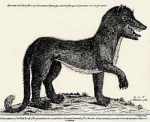
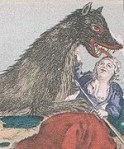
Images: Artist’s conception of one of the Beasts of Gévaudan, 18th-century engraving by A.F. of Alençon, and An 18th-century print showing a woman defending herself from the Beast of Gévaudan
Someone finally thought to ask the museum about it and actually got an answer. They went to the Paris Museum of Natural History where the taxidermed corpse was put on display. After digging through the paperwork and records the curator said “Yeah, we have it’s bones. It was a Spotted Hyena.”
The couldn’t keep the pelt because it was taxidermed more than a month after the animal was killed and it was really rank shape, but the bones were sketched, documented and then reused in the collections many other Hyena specimens.
Recycling bones is actually extreamly common in diorama displays. They’ll get knocked over, dropped during rearrangement, some one tries to sit on it, just a really bad taxidermy job, someone throws paint on them in “protest”… so yeah. naturally, they’ll replace broken bones with ones from animals that have no pelt to display.
Nice addition!
This is actually not completely true. Paris Museum of Natural History does have a notice mentioning the beast, and once hold its ‘remain’ (not the actual remain, the modified remain presented to the king after the first ‘killing’ of the beast in 1765, the murders continued until 1667 and the second and definitive killing of the beast by Jean Chastel). Paris Museum of Natural History never held the remains of the probable real beast which were poorly stuffed and rapidly lost after the autopsy. In addition said notice was never linked to the remains of the ‘official’ beast (which are also lost nowadays). It was written in 1819 (so 150 years later in a Post-revolution France) to described an identified stripped hyena and this is what it states:
“Ce féroce et indomptable animal est rangé dans la classe du loup cervier ; il habite l’Égypte, il parcourt les tombeaux pour en arracher les cadavres ; le jour, il attaque les hommes, les femmes et les enfants, et les dévore. Il porte une crinière sur son dos, barrée comme le tigre royal ; celle-ci est de la même espèce que celle que l’on voit au cabinet d’Histoire Naturelle, et qui a dévoré, dans le Gévaudan, une grande quantité de personnes.”
“This ferocious and untamable animal is classified as a lynx; it lives in Egypt, it goes through tombs to snatch the corpses away, by day, it attacks men, women, and children, and eats them. It has mane on its back, stripped like the royal tiger; it is from the same species as the one we see at Natural History cabinet, and which has eaten, in Gévaudan, a lot of people.” (Translation by me)
As you can see the notes itself is pretty clear that this stripped hyena wasn’t the beast of Gévaudan. In addition the first beast killed by François Antoine, aka the fake one, was most certainly a wolf, meaning that the actual remains the Natural History cabinet once hold were the ones of a wolf. Which means that this hyena holden by the Natural History cabinet wasn’t François Antoine’s kill or Jean Chastel’s one (aka the probable real beast). However the hyena theory stays the most popular animal in the ‘the beast of Gévaudan was an exotic animal’ theory which is not the most popular theory.
The most popular theory are a wolf or a wolf pack gone wrong and men-eating (boohoo boring and in my view incoherent). And an hybrid wolf and dog is the second most popular theory, it works with the autopsie report of Chastel’s kill (which conclude without equivoke to a canid without identifying a wolf which he would have been to do considering the huge presence of wolf in Auvergne/Gévaudan at the time), it works with the hypothesis that the beast was a tamed animal (displayed some behavior pointing to the fact that it was tamed).
But in the end the mystery of the Best of Gévaudan is still unresolved. And this is a shame because I want to know so bad!
 Mooncustafer