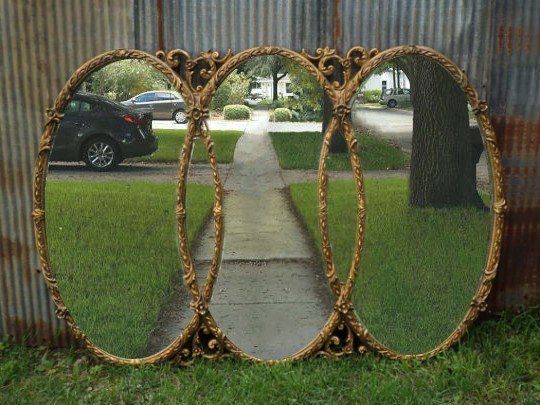
Im so glad faerie portals are coming with options these days
How the fuck was this photographed
How the fuck was this photographed
the second pic made me feel such an enormous amount of dread and i fear that if i turn around, he’ll be standing right behind me and i will finally learn the truth of what he had to do
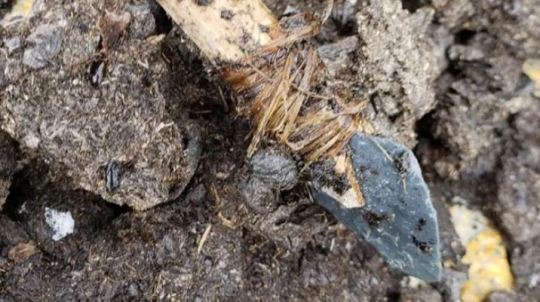
At first, Jennifer Herkes didn’t realize what had been found — she thought it was a piece of an atlatl dart.
“I thought, ‘Oh yeah, that’s neat,’” she recalled.
Then she saw it wasn’t just a piece — it was the whole spear.
“My heart rate started increasing, and I got goose bumps all over. I’d never seen anything like that before, it was amazing,” said Herkes, who is the heritage manager for the Carcross/Tagish First Nation in Yukon.
“The feathers, the sinew, the sap they would have used as, like, a glue to attach the stone point to the wood shaft — all of it is completely intact.“
Herkes believes it’s the first full atatl spear ever found in Yukon. It’s believed to be at least 1,000 years old. Read more.
Ehehehehe, well, I am only a fake historian of Christianity, and depend on maaaaaaany longsuffering divinity-school friends to keep my theology straight ; P I got to religious history via my interest in hymnody. The area where I grew up (at least the rural parts) are very strongly Plain; we have the world’s biggest population of Church of God in Christ, Mennonite to which many of our neighbors belonged. My childhood best friend was a Holdeman Mennonite but lived about a three-hour drive away, so my best opportunity to get to see her was at the monthly gospel singings at the Mission Church in Dodge City. (They actually sing three times a month, but the other two are in Spanish and Plautdietsch!) The best friend’s aunt is also a prolific and pretty well respected hymnodist within that denomination. I had started to read a lot of hymnological research by the time I was ten or so. When I was twelve I happened to come across a library copy of the facsimile of James Lyons’s Urania (1762, usually considered the first “American tunebook”) and I sort of followed Lyons forward and the Mennonite repertoire backward until I ended up in the early nineteenth century. Bar a little writing about Richard Allison at the turn of the seventeenth century, I haven’t really ventured before 1800 or after 1850 since!
Hymnology had such a draw on me because I enjoyed the music and the texts, but I’ve always been distressed by the tendency of a lot of writers on hymnody (especially those whose disciplinary background is in musicology *cough*RichardCrawford*cough*) to focus on the music and brush over the religious context. I’m coming from such a different religious background that I’ve had to labor and labor and read and read just to attain the basic understanding of the Christian ideas/symbols/idioms that pop up in hymnody and that culturally Christian musicologists can simply accept at face value and move on from. I think that has made me a little more sensitive to disjunctures between what I was reading in primary sources and the standard historiographical narratives, and a little more curious about how sacred music actually functioned within the devotional lives of people whose view of the world was so radically different than mine. Tl;dr, I like hymns, but it turns out that you have to know religious history to understand the hymn repertoire in the ways I’m most interested in understanding it.
I like to joke that when I totally don’t get a thing, my instinctive response is to try and get it harder. I don’t experience music as a deeply emotional sensation the way many people do, and Christianity still doesn’t make a lick of sense to me. Obviously, I’m writing a dissertation about nineteenth-century Christians getting way too worked up about/by music ( ;




 Mooncustafer