
For out of it wast thou taken: from the curb thou art, and unto the curb shalt thou return.
Me, to my erstwhile desk (via shelomit)
For out of it wast thou taken: from the curb thou art, and unto the curb shalt thou return.
I didn’t write it, but I did link to it! The Cap/Iron Man Slashy Moments List is here.
However, I want to add on some personal commentary, which is that unless you are trying to evangelize this to your friend and not taking no for an answer (I don’t know if you are doing this or not, so I’m just putting it out there), then who is she to judge what you ship? Next time she says something like “Oh, you ship everything” say “Why do you care? Does it make you feel better to look down on me for that?” and if she says “There’s no evidence for that in canon,” say “This isn’t Lit 201, I’m not being graded on things I enjoy.”
I mean, arguing this point seems like wasting time on someone who, from what you’ve said, is just shaming you for enjoying things. You don’t have to defend your ships to her. I ship Clint/Coulson despite them having spoken exactly twice in the MCU, and I don’t bother defending it because Go Fuck Yourself, That’s Why, I get to enjoy shit if I want to. Your shipping is entirely predicated on fictional people who have been themselves written by anywhere from two to twenty different people over the course of decades. It doesn’t have to be evidence-based. Do I understand Lestrade/Mycroft as a ship? I do not. You know what I do when people are talking about it? I shut up and let them enjoy themselves.
You also don’t have to defend how many ships you have.
Like….so what if you are shipping for the sake of shipping? It’s called Enjoying An Idea. And there’s nothing wrong with thinking everyone is gay. Most people think everyone is straight and nobody gets on their case for it.
And the real problem is that if she thinks you’re sad or unrealistic or handwave-whatever for shipping or for your headcanons, no amount of canonical evidence or protesting that you have very few ships is going to change her mind. She’s found a reason to feel superior to you and she’s not going to let that go. It has nothing to do with the ship and everything to do with making you feel bad for having passions. And life’s too short to put up with insecure killjoys.
“Cities have often been compared to language: you can read a city, it’s said, as you read a book. But the metaphor can be inverted. The journeys we make during the reading of a book trace out, in some way, the private spaces we inhabit. There are texts that will always be our dead-end streets; fragments that will be bridges; words that will be like the scaffolding that protects fragile constructions. T.S. Eliot: a plant growing in the debris of a ruined building; Salvador Novo: a tree-lined street transformed into an expressway; Tomas Segovia: a boulevard, a breath of air; Roberto Bolano: a rooftop terrace; Isabel Allende: a (magically real) shopping mall; Gilles Deleuze: a summit; and Jacques Derrida: a pothole. Robert Walser: a chink in the wall, for looking through to the other side; Charles Baudelaire: a waiting room; Hannah Arendt: a tower, an Archimedean point; Martin Heidegger: a cul-de-sac; Walter Benjamin: a one-way street walked down against the flow.”
— Valeria Luiselli, “Relingos: The Cartography of Empty Spaces,” in Sidewalks
Alexandre Dumas: SECRET TUNNELS EVERYWHERE JUST FOR THE HELL OF IT

El vampiro / ICE
El vampiro torce la ley.
Como arroz, es blanqueado
de compasión. No llega
cuando prometas,
y entra sin permiso.¿Cuál depredador
se anuncia? El sanguinario
caballero lanza la voz;
dice que es policía,
vecino, amigo. Roba
tus padres y les transforma
en criminales sobre el papel.No es posible razonar
con el vampiro. La única solución
para él es clavar la estaca
en el corazon.The vampire loves the law.
Watch him count rice on the doorstep,
grain promises. He does not arrive
unless invited, or at least,
he does not come in.Like a predator, the sanguine
gentleman announces himself.
He has no need to throw his voice.
The doctrine of his castle
is orderly as stone;
he takes nothing
he is not authorized to take.The vampire is reasonable.
If you don’t want him
to steal your blood, simply
don’t answer the door.P.S. Raices Texas, New Sanctuary Coalition. Call your congresspersons and tell them it’s time to abolish ICE.
First off: holy fucking shit. You have outdone yourself again. This is an incredibly powerful piece.
Secondly: my attempt at a translation, under the cut.
Thanks to @signed-me-again for this translation! I mean, I know what I was trying to say, but as ever, it’s such a beautiful gift when people engage with the text in this way and show me what they took from the Spanish.
A-B-O-L-I-S-H I-C-E
E.M. Forster: The case of Dickens is significant. Dickens’s people are nearly all flat (Pip and David Copperfield attempt roundness, but so diffidently that they seem more like bubbles than solids). Nearly every one can be summed up in a sentence, and yet there is this wonderful feeling of human depth. Probably the immense vitality of Dickens causes his characters to vibrate a little, so that they borrow his life and appear to lead one of their own. It is a conjuring trick; at any moment we may look at Mr. Pickwick edgeways and find him no thicker than a gramophone record. But we never get the sideway view. Mr. Pickwick is far too adroit and well-trained. He always has the air of weighing something, and when he is put into the cupboard of the young ladies’ school he seems as heavy as Falstaff in the buck-basket at Windsor. Part of the genius of Dickens is that he does use types and caricatures, people whom we recognize the instant they re-enter, and yet achieves effects that are not mechanical and a vision of humanity that is not shallow.
me, anti-anti-intellectual: dickens characters ace attorney witnesses
Mr. Pickwick, 2D, scuttling sideways like a crab: no one must learn my shameful secret

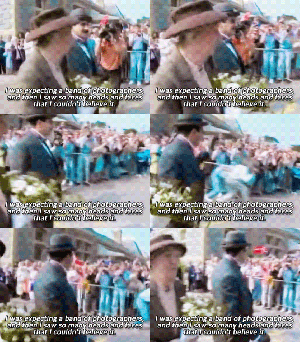
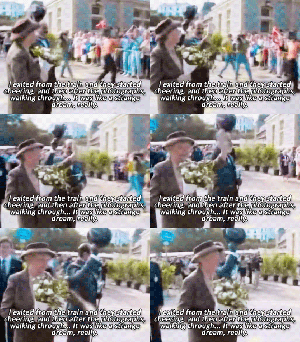

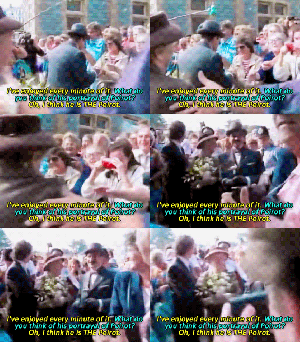
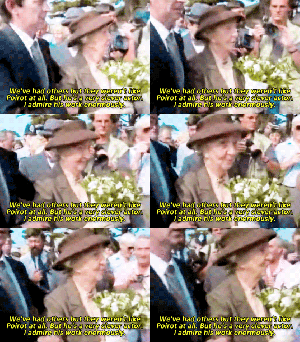



Poirot and Miss Marple actors David Suchet and Joan Hickson meet for the first time in 1990 for Agatha Christie’s centenary celebration in her hometown of Torquay [x] [x]
+ Bottom pic: David and Joan with Poirot co-stars – Hugh Fraser, Pauline Moran and Philip Jackson – in the background also dressed up as their characters Captain Hastings, Miss Lemon and Chief Inspector Japp
“I was told there were nearly 3000 people there. I’d never believed for one moment that would have been the case, and I was absolutely knocked off my feet.” – David Suchet
Actors playing the joker in a live action movie: it gets in your head…it scares you…it makes you wonder where you begin and the joker ends…
Mark Hamill: yeah sure. I’ll do my Joker for Robot Chicken.
What I think is really interesting about the papyrus account of the workers building the tomb of Rameses III going on strike to demand better wages is really fascinating to me because if you look at the description given by the royal scribe you see that there was an attempt to satisfy the workers by bringing a large amount of food at once but that was rebuffed by the workers who declared that it wasn’t just that they were hungry at the moment but had serious charges to bring that “something bad had been done in this place of Pharoah” (is poor wages and mistreatment). They understood themselves as having long term economic interests as a -class- and organized together knowing that by doing so they could put forward their demands collectively. It so strongly flies in the face of narratives that are like “in this Time and Place people were happy to be serve because they believed in the God-King and maybe you get some intellectual outliers but certainly no common person questioned that”. If historical sources might paint that sorta picture of cultural homogeneity it is because those sources sought not to describe something true but invent a myth for the stability of a regime.
Since this is getting notes here’s a link to a translation of the papyrus scroll and here’s an article that gets further into the economic situation surrounding the strike and giving an explanation of the events. The workers didnt just refuse to construct Rameses III’s future tomb, they actually occupied the Valley of the Kings and were preventing anyone from entering to perform rituals or funerals. Basically they set up the first ever recorded picket line
Again the workers went on strike, this time taking over and blocking all access to the Valley of the Kings. The significance of this act was that no priests or family members of the deceased were able to enter with food and drink offerings for the dead and this was considered a serious offense to the memory of those who had passed on to the afterlife. When officials appeared with armed guards and threatened to remove the men by force, a striker responded that he would damage the royal tombs before they could move against him and so the two sides were stalemated.
Eventually the tomb workers were able to win the day and acquire their demands and actually set a precedent for organized labor and strikes in Egyptian society that continued for a long time
The jubilee in 1156 BCE was a great success and, as at all festivals, the participants forgot about their daily troubles with dancing and drink. The problem did not go away, however, and the workers continued their strikes and their struggle for fair payment in the following months. At last some sort of resolution seems to have been reached whereby officials were able to make payments to the workers on time but the dynamic of the relationship between temple officials and workers had changed – as had the practical application of the concept of ma’at – and these would never really revert to their former understandings again. Ma’at was the responsibility of the pharaoh to oversee and maintain, not the workers; and yet the men of Deir el-Medina had taken it upon themselves to correct what they saw as a breach in the policies which helped to maintain essential harmony and balance. The common people had been forced to assume the responsibilities of the king.
[…]
The success of the tomb-worker/artisan strikes inspired others to do the same. Just as the official records of the battle with the Sea Peoples never recorded the Egyptian losses in the land battle, neither do they record any mention of the strikes. The record of the strike comes from a papyrus scroll discovered at Deir el-Medina and most probably written by the scribe Amennakht. The precedent of workers walking away from their jobs was set by these events and, although there are no extant official reports of other similar events, workers now understood they had more power than previously thought. Strikes are mentioned in the latter part of the New Kingdom and Late Period and there is no doubt the practice began with the workers at Deir el-Medina in the time of Ramesses III.
iirc what little I know of ancient Egyptian beliefs, preventing the food offerings wasn’t just “a serious offense to the memory of those who had passed on to the afterlife,” it was *cutting off their food supplies in the afterlife.* The strikers blockaded the Land of the Dead until they got justice.

I wonder how smear frames were invented.
Not just the “movement faster than the framerate” kind, though that’s obviously what I’m looking at right here. When did that first animator go “Huh, you know, people don’t really see this stuff frame by frame. I can do better and faster motion by making the in-between frames Real Fuckin’ Weird”?
The Dover Boys.
Yeah, the ones from the memes. 1942, Chuck Jones was like “hey, instead of trying to copy reality like they do in those Disney cartoons, what if we utilize these inbetweens for wackier, funnier movement and emphasis on keyframes?” The technique was so unpopular it very nearly got him fired.
#ah!!! a keyframe! i’ll smear it! no one will ever know!!!!!!
 Mooncustafer