Which didn’t sound right to me just cuz it felt like determining what someone is gonna be like before they even do anything like some gattaca ass shit ya know. Then I think he tried to tell us that some races have naturally higher IQs than others which I KNOW to be bullshit. And I missed a class so I went to the prof to go over what I missed and apparently that day they learned about race. And the prof told me that they learned about how u can tell the different races based on skill shape so when he said the thing about skulls and race I asked him if that’s actually true because I thought that was old and very bad race science that was debunked like a century ago. As he said “ no it’s true you can measure the skull to find out what race someone is” and then he said….. “I tried to pull up pictures to show everyone what I was talking about but all I could find were on those white supremacy websites!”
(I’m sorry this is so long) so I have a question that’s probably gonna sound dumb given what I know but like: is there even a shred of truth to what he’s saying or was he just a racist old man teaching about human evolution, something that racist old me should stay the fuck away from imo. Like I obviously don’t know that much about the human skeleton but I do know race isn’t real the way this guy suggested it.”
Thanks anon! A lot to unpack here holy shit. I don’t have all the answers (bio ants will probably comment on this, which I encourage).
First, bio ant professors typically go through the rigmarole of showing their students that race is a social construct. That this isn’t the first go-to is really a failure on your professor’s part (unless he said it during your absence… who knows). Second, it’s in your right to report this to the dean of students, most universities will have some online form or something, but know it likely won’t go anywhere due to ‘academic freedom.’ Write it in the evals too.
Third, as to whether or not it’s true, bio ants will use various parts of the body to find what people call ‘race,’ really finding ancestral traits common to groups deriving from certain areas of the world. Using the skull size though? Don’t like that. Using the word race to describe it? Also don’t like that.
Fourth, I took this stats class, and he was a weird dude, gave us a lot of articles showing statistically that white people have higher IQs. He also gave us articles on how DNA could predict violence – stuff that is actually contemporary in behavioral science and statistics. I, and others in the class, would discuss ‘why’ this is. To say that it’s “natural” is a matter of opinion, not proven fact. Telling students it’s a fact, and teaching it as a fact, is wrong. Anthropologists and other social scientists look to environmental factors for why white people have higher IQs – white supremacy, discrimination in education, class discrimination in education, and the arbitrariness and Western-ness of an “IQ test.”
Fifth, fuck that dude. You’re going to have a lot of professors who are incompetent morons. Old straight white men made it to where they are in academia today because they were the only ones allowed in academia before. Half of these jokers are a fucking laughing stock among academics who happen to not be straight, white, or men. Try not to let it affect you too much (i’ve had incidents like this where it really hurt my happiness and mental health that semester), there are good people there, make sure to seek them out and ask for their advice on this. They will likely be understanding. Vent about it to your therapist. Good luck!
Hi! I am a biological anthropologist. I’m a grad student who’s TAd and taught ANTH 105 at my school so many times and honey child your professor is dead wrong. Embarrassingly so. Extremely long post incoming; I hope you find it helpful and that it makes sense.
The American Association of Physical Anthropologists released a positional statement on this topic more than twenty years ago, and your professor is violating pretty much every part of it. I don’t know if you’re American or not, but this position is pretty much the global standard in bioanth. There is no necessary concordance between biological characteristics and culturally defined groups. If you have time, read that whole statement. Perhaps print it out and show it to him, or nail it to his door, Martin Luther-style.
Second point- don’t just address the dean. If he’s tenured, there might not be a lot he can do. Address the department head, too. Unless he is the department head, in which case pester the director of undergraduate studies. Leave a review on Rate My Professor- students USE that, they should know that he’s a lazy racist. If he’s too lazy to keep up with current research and scientific paradigms, then he’s too lazy to be teaching this course.
Now, I’d like to expand on that third point, and please bear with me, because this is a tricky subject that requires a lengthy explanation to get the nuances down. Within bioanth, there’s basically a consensus that cultural race and skeletal anatomy are totally unrelated. However, it’s also true that statistically, traits within descent group populations tend to cluster.
This doesn’t mean that everybody of X descent is going to have similar skeletal features; it means that people of X descent who live geographically near each other and have kids together will likely have traits that look similar to each other. It does not necessarily mean that these traits will show up in people of X descent on the other side of the world.
So, can you use metric traits to determine race?
No.
Can you use metric traits to get an assessment of ancestry that shows phenotypical trends within a descent group that lives in a certain area, understanding that these trends won’t be the same anywhere else due to the way humans typically choose mates with similar characteristics?
Yes.
Why would you want to do this?
Forensics. Mass graves. Long-forgotten war dead. Historical cemeteries where that particular cultural race context makes knowing this valuable to understanding who’s who. Etc.
Does it work all the time?
No.
So, there’s the quick answers, and now I’ll go into detail. Race as a biological concept is absolutely useless in humans. We simply do not have the genetic diversity to have biological races. But it is true that certain population groups will have phenotypical trends, and that these trends cluster. The AAPA statement explains it thusly:
“Generally, the traits used to characterize a population are either independently inherited or show only varying degrees of association with one another within each population. Therefore, the combination of these traits in an individual very commonly deviates from the average combination in the population. This fact renders untenable the idea of discrete races made up chiefly of typical representatives.”
So these? These are stereotypes.
Comparisons like this are useful in showing diversity of cranial morphology, but they’re not useful for comparing other skulls to for identification purposes. The idea that cranial size, brain capacity, and other such metrics are even remotely useful for assessing ancestry… it just doesn’t work. There’s too much diversity within populations.
What can be useful for assessing ancestry is painstakingly measuring all kinds of tiny features on the skull and then doing math to it. What this means is that when you have cranial fragments or a few skeletal elements and you need to narrow down who they could possibly be, you take measurements and then you feed them into a stats program called FORDISC. FORDISC then compares those measurements to an enormous database of measurements of people with known ancestry (many of whom donated their bodies, etc.) and gives you an output that says “this person is statistically likely to be of X ancestry based on these measurements.”
Not “is,” “is statistically likely.” The key thing here is that FORDISC compares the measurements to people from known ancestry and known regional origin. All FORDISC is saying is that the person you’ve found looks much like these people. Perhaps that’s who this person is?
Let me give you an example here of how this works, and how important context is.
In 2009, Lyle Konigsberg did a study, published as “Estimation and evidence in forensic anthropology: Sex and race” in the fantastic AJPA special edition “Race Reconciled: How Biological Anthropologists View Human Variation.” His team looked at bones found in an Iowa creek and compared their measurements to various databases.
From the article: Using the Iowa priors, the highest posterior probability is for “American White” at 0.6976. The identification of “Easter Islander,” which had the highest posterior when we used an uninformative prior, now has a relatively low posterior probability (0.0449). In contrast, using the Hawaii priors the posterior probability that “Mr. Johnson” was an “Easter Islander” is 0.9068, whereas the posterior probability that he was an “American White” was 0.0188. Using the Gary, Indiana prior the highest posterior probability (0.5342) was for “American Black” with “American White” having the second highest posterior probability (0.2728) (Konigsberg et al. 2009:82)
Or in other words, without the context, those bones couldn’t have told them anything useful. If you’re investigating a murder and you find those bones and don’t use their proper context, you could be checking missing persons records for missing black individuals while in reality your vic is a white guy. Not helpful for your investigation. Not helpful at all.
And you don’t do this for every body. You do this when you need to narrow down a case and find a potential ID FAST. FORDISC can be wrong, too, even with context- cranial trauma, abnormal bone growth, bone cancer, all these things can throw it off. But FORDISC doesn’t care about your lived experience. FORDISC doesn’t care about how your ancestry affected you in life. The only thing FORDISC is really interested in is helping figure out who you are so it’s easier to find out who or what may have killed you.
Finally, cultural race and ancestry are not the same thing. It’s naive to say that race isn’t real- saying that absolutely denies the lived experience of marginalized and colonized populations. It is also naive to say that biological race isn’t real. Biological race is absolutely real and by its definition, humans cannot have it. It’s important to understand that biological race is a real thing, because that gives us a definition that we just… just don’t meet. There’s not enough diversity between populations for the race concept to work with us, and attempting to force it to apply is bad biology. Cultural race is a shorthand for so very many things, and it can have serious biological impacts- but that’s not an aspect of underlying biology, that’s an aspect of culture. But it’s not a shorthand for biology, and it’s not a shorthand for heritage. There’s a reason we don’t do FORDISC in 100-level classes; the idea of shared inheritance and statistical likelihood of ancestry just doesn’t work unless you fully grasp that there’s too much diversity within populations to define humans using biological races.
Otherwise you’re finding dead Easter Islanders in an Iowa creek bed.
Resources
If you’d like to learn more about the interplay between race, racism, and biology or are wondering where the heck I’m getting this stuff, Clarence Gravlee’s article “How Race Becomes Biology” is necessary. It’s a sobering look at how prejudice and stress can literally embody racial tensions in human populations. From the abstract: “In the United States and elsewhere, there are well‐defined inequalities between racially defined groups for a range of biological outcomes—cardiovascular disease, diabetes, stroke, certain cancers, low birth weight, preterm delivery, and others. Among biomedical researchers, these patterns are often taken as evidence of fundamental genetic differences between alleged races. However, a growing body of evidence establishes the primacy of social inequalities in the origin and persistence of racial health disparities. Here, I summarize this evidence and argue that the debate over racial inequalities in health presents an opportunity to refine the critique of race in three ways: 1) to reiterate why the race concept is inconsistent with patterns of global human genetic diversity; 2) to refocus attention on the complex, environmental influences on human biology at multiple levels of analysis and across the lifecourse; and 3) to revise the claim that race is a cultural construct and expand research on the sociocultural reality of race and racism. Drawing on recent developments in neighboring disciplines, I present a model for explaining how racial inequality becomes embodied—literally—in the biological well‐being of racialized groups and individuals.”
It’s such an important article. If you can’t get, let me know, and I’ll get you a PDF. Leave a request in the notes, my ask box is off.
That whole journal edition’s great. It’s AJPA Volume 139, Issue 1, Race Reconciled: How Biological Anthropologists View Human Variation. Again, let me know in the notes if you’d like a PDF of it and can’t get one.
If you’d like a better comprehensive textbook understanding, Jonathan Marks’s The Alternative Introduction to Biological Anthropology, 2nd Edition, is good.
Nina Jablonski’s book Living Color: The Biological and Social Meaning of Skin Color is fab. Most people associate race and skin color, and Dr. Jablonski’s done a ton of work on figuring out why human skin pigmentation is as diverse as it is and what that means from an ancestry standpoint. If you have fifteen minutes, listen to her TED talk on it: https://www.ted.com/talks/nina_jablonski_breaks_the_illusion_of_skin_color
You should also look at the AAA’s work on race. They did a project back in 2007 called Understanding Race and it’s still up as a website, as well as a traveling exhibit.
Anthropologists above, thanks for correcting the professor’s
wrong info on race. I’m just going to add that even before that, I boggled at:
“And he says things like “if this person has this many xs
then he’s gonna be really aggressive and more prone to violent crime”
OK, I think what that means is that your professor still
thinks that either people with Kleinfelter Syndrome, (usually) AMAB individuals
whose karyotype is XXY; or XYY individuals,
who also exist – are more prone to criminal, violent, or thrill-seeking behavior.
The reason this was once posited is that studies of unusual
chromosomes, back in the 1950s, were done on prison populations, and included
people going “omg maybe we’ve found the gene for criminal behavior!!!”
There was even a British novel/TV series in the 1960s called
“The XYY Man” in which the hero, “Spider” Scott, a former burglar, can’t resist
taking dangerous missions because his extra Y chromosome makes him super-manly and
therefore desperate for excitement.
Then they did further studies and realized these karyotypes occur
at about the same rate in the general, non-prison population either.
TL:DR – if your prof *still* thinks Kleinfelter or
similar syndromes are associated with violent behavior that’s a pretty big red
flag in itself.
And all these people call in, sharing their own memories of this mysterious Cryptid named Logan who is apparently an immortal, grumpy, wandering dad-friend who’s also a patriot and he helped punch out Nazi’s and free camps and beats up assholes who don’t respect women. And the whole while Logan is watching this from a TV screen with Kitty or Rogue holding his hand so gently, after they dragged him to the couch in a hurry. “You recording this?” “Don’t worry, we won’t let you miss a single word.”
Okay but if we’re gonna do this we’re gonna do this HARDCORE HISTORIAN STYLE, and it initially comes up while Steve is being interviewed for a book about the Howling Commandos or a bit for the History Channel or something. Because this person is like “Hey, there are a bunch of stories of you showing up somewhere with only one dude for backup, was that Bucky?” And we’ll assume that this is before the whole Winter Soldier thing, so that’s not a hideously loaded question.
And Steve kind of laughs and he’s like, “Oh, wow, God, that was actually this dude on detached duty from the Canadian special forces, he and I got sent on a bunch of missions together. His name was Logan, he was the weirdest guy I ever met, and I knew some pretty weird guys, but he could take a hit even better than I could, so when the Howlies were laid up, they sent us out together.” And he launches into this story about how one time he and Logan stole a plane complete with pilot and stormed a prison camp that was holding German Jews before sending them up to Poland, and the historian he’s talking to is taking frantic notes and trying not to drool because THIS IS A NEW GUY. CAPTAIN AMERICA’S STORY IS METICULOUSLY WELL DOCUMENTED BUT NO ONE’S EVER MENTIONED THIS GUY.
There are no pictures, obviously, so Steve does a sketch for this historian, because he’s helpful like that and also because. Like. Listen. Steve’s been through a lot of weird shit, and to be sure this Logan he used to know could take a bullet and keep coming no problem, but this dude’s probably been dead fifty or sixty years. No harm in giving him a little posthumous glory, right?
So this historian runs back to her university and starts doing research on the Internet. She reaches out to her coworkers first, then to anyone else she knows, then to the premier WWII and Captain America scholars of the world, and asks all of them “Do you happen to know who the fuck this dude is?”
And like, no, they don’t. They’ve got no idea. Steve’s not even totally sure what the guy’s real last name was, because Jameson is common as hell and there’s no Logan Jameson on the books. So they start doing research into this WWII cryptid, and finally they reach an old woman who listens to her grandson’s boyfriend talk passionately about this new project he’s working on and goes “Oh, yeah, I met Cap in Germany one time, there was a guy with him who sounds kind of like what you’re talking about.”
This passionate history major immediately sends an email in all caps to his adviser and it just says “MY BOYFRIEND’S GRANNY KNOWS WHO WE’RE TALKING ABOUT PLEASE COME TO KANSAS ASAP THANKS” or whatever, because, listen, historians are Like That. Speaking as someone who could easily have claimed to be a history major based on my thesis, I would have gone to Kansas in 0.2 seconds if someone had been like “What’s up we found that book you were after but we can’t take it out of the museum.” It does stuff to you. Trust me here.
So this woman tells the story of how Cap and his weird buddy broke her and her mother and father out of a temporary prison camp, and this history professor immediately takes all the tiny bits of information and starts asking around, looking for literally anyone else who knows this Logan dude. He saved your ass one time in Paris? He gave you some rations in Berlin? He beat your grandfather’s ass in Russia? He took three bullets for you? You had a passing conversation? This historian and his extremely pumped undergrad who just changed his senior thesis want to hear about it.
And then someone gets in touch with them and is like “Hey, I know you’re looking for WWII stories, but this guy saved my dad’s entire unit on the Somme and I have pictures?” And someone else is like “Hey, I have a file from a Vietnam MASH unit for a Logan who looks like that guy, do you want it?” And someone else is like “Uh, fuck all of y’all, I think this is him in the Civil War, what do I do about that?”
AND SO BEGINS LOGAN, THE HISTORICAL CRYPTID.
This undergrad is taking an extra year of college and basically getting a Bachelor’s degree in Tracking Weird Mutants Through History, and also his adviser is very lucky to be on tenure, because otherwise he would have been laughed out of the college three times by now. But there is an absolute preponderance of evidence, is the thing, so it just turns into this massive quest to investigate exactly whether or not Logan the Mystery Dude was actually in China for the Boxer Rebellion or whatever.
Forget this being a collaborative effort between colleges, there are multiple continents involved in this by now. Canadian government is under pressure to turn out their WWII special operations files for this guy from five different big name universities in five different countries, including their own. Things are getting a little wild in academia. Steve’s been interviewed nine times and he has a filter set up in his email specifically to catch stuff from the University of Toronto.
It takes a little bit for Kitty’s bubbe to get a phone call. Kitty’s bubbe has been living a quiet-ass life in Illinois and likes it that way, especially because her last name is not Pryde and therefore Kitty and her weird friends can crash at Bubbe’s house whenever they’re in the area without any trouble. It’s fine if her granddaughter wants to run around in spandex and save the world and shit, she’s honestly much more chill about it than Kitty’s parents, but Bubbe does not care for news crews in her neighborhood thank you very much.
But so eventually this nice old Ashkenazi woman gets a phone call from an extremely pumped undergrad who read a very brief statement she gave in a news article forty years ago about Captain America, who she is very grateful to for breaking her, her older sister, and their little brother out of a prison camp during WWII and also helping them get across the border. Did she happen to see anyone else? Why yes, very polite young man, the Captain had another man with him, he was very grumpy but he let my brother ride on his shoulders so I liked him very much. That’s great, would she mind if someone came and talked to her about that? No, very polite young man, not at all, when would work for you?
And she gives Kitty a call that night, because she gives Kitty a weekly call since Kitty and her parents are going through a rough spot to the tune of “please God stop risking your life//listen I’m saving people I’m not going to stop learn to cope”. Bubbe mentions offhand that she’s going to have a talk with this very polite young historian about the Shoah and Kitty’s understandably a little concerned for her bubbe’s mental health, and asks some questions.
So Kitty hears her bubbe out in increasing degrees of shock, hangs up the phone, and immediately goes and does an extensive google.
Then she goes and hammers on Logan’s door until he says to come in, slams her computer down in front of him, and says “Holy shit, Logan, why didn’t you tell us that you knew Captain America?”
“Uh, because I mostly didn’t,” Logan says, wary. “Don’t remember that much.”
“You might want to take a look at this, then,” Kitty says, and Logan looks through her fifteen tabs and thanks her and calls the university that seems best informed.
Which is the story of how an extremely pumped undergrad gets a phone call from the object of his thesis that opens with “This is gonna sound pretty fuckin’ wild, but my name is Logan and I’m pretty sure you can catch me up on the last hundred years better than I can.”
Oh, and then Logan and Steve meet up again and it’s very nice and sweet and that undergrad gets a full ride to the PhD program of his choice. The full ride’s name is actually Tony Stark, who’s doing a favor for Steve, who’s doing a favor for Logan, who’s secretly doing a favor for the undergrad, but no one really knows that.
One of the animated X-Men series did this in reverse – the one
story featuring Captain America (who’s still in suspended animation) contains
an extended flashback in which Logan tells the younger X-Men about the time Cap
and “uh, another guy” busted some people out of a camp (described as a POW
camp, pretty obviously a concentration camp from the visuals) and at the end of
the episode Magneto comes in to help Logan save still-frozen Steve Rogers from
destruction because he was a kid they rescued.
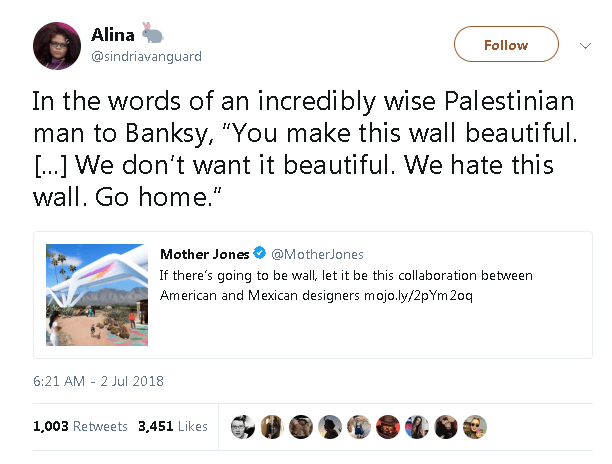
Protest of the Berlin Wall in Leipzig (October 1989)
Unfortunately this dinosaur and their sign are relevant again…
I like the photo, but given that Jurassic Park came out in 1993, and that looks like one of those
inflatable T-rex costumes that came on the market in the past couple of years,
I think the caption is a joke.
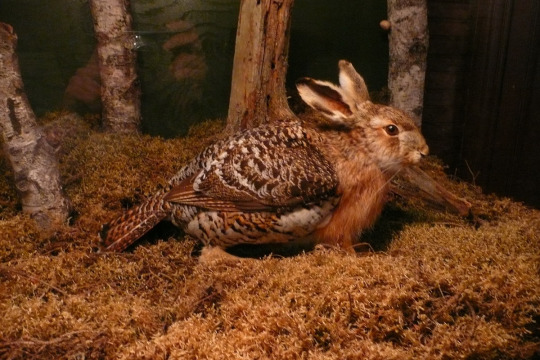
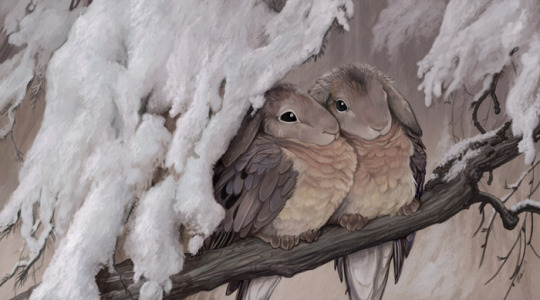
there aren’t enough posts going around about the swedish cryptid known as the skvader which is a rabbit with pheasant wings and also a very good boy.
like this one dude just made a fake taxidermy and spread it around as a hoax for a good ass while and it lead to this really cool fantasy creature and i am genuinely dissapointed that it never gets used in anything
THE BOY
Rabbirds, by the amazing @tkingfisher/Ursula Vernon (source).
The lack of skvaders is particularly frustrating when you realize it forms the third point of a wonderful cryptid trifecta.
You got the jackalopes, which are rabbits with antlers.
And you got the wolpertingers, which are rabbits with antlers and wings.
And then… what? Do you escalate? That’s unbalanced, those two rabbit cryptids don’t have the same number of extra things, the wolpertinger is clearly the jackalope But More.
BUT with the skvader on the other side, balance is restored. Antler rabbit, winged rabbit, winged antler rabbit. It’s a classic Venn diagram of imaginary lapine beasts, and it’s only complete if you acknowledge the fucking skvader.
Good thing Ursula’s got our back, at least.
This is a really excellent point and I applaud your advancements in Cryptid Theory.
There may be two additional points on this diagram – one is
the Furbearing Trout. The other, the Rabbitfish mentioned in the Monty Python sketch
“Dead Bishop on the Landing.”
I think a lot about who I am to other people in the world–particular who I am to strangers as a mere concept in their lives.
Today this woman called our information desk and said, “my son’s band is playing tonight. I want to come see him, but he never answers his phone…..I want to be there. Have you heard anything about his band?”
And I felt so bad for this lady but I’m not in the music scene around here so I had to tell her no, sorry.
Five hours later, I’m hiking and run into a group of guys setting up for some outdoor performance, and as I watch them unload the drums it hits me.
“Hey,” I said, “are y’all in a band?”
They said yeah and smiled and I told them “one of your moms called today. She wants to watch you play, but she can’t get a hold of you. Call your mom.”
And they all pulled out their phones and started discussing whose mom it probably was as they presumably dialed their own.
And now, unless we meet again and recognize each other, that’s who I’ll be forever to those guys–some mysterious courier for mom-messages who came out of the woods and told them their mom called.
I didn’t even tell them why their mom called me. Who am I to their mom?? Nobody even asked. They just took my word for it and called their mothers.
Amazing.
I’M LAUGHING!!! THEY DIDN’T EVEN ASK WHO I AM.
This is how legends about mysterious supernatural messengers
get started.
guys lmao I went back to watch some old law and order svu episodes and there’s this one scene where a girl claims her alibi is she went to see the phantom of the opera and to confirm whether or not she’s telling the truth the detective goes, ‘oh yeah I love phantom of the opera it’s so sad when the guy goes to prison for stealing bread’ and the girl AGREES and later he’s telling his partner ‘yeah she’s lying there’s no bread in phantom’
There’s a bit in the original British version of Cracker where a character asks her husband where he was that afternoon, and he claims to have taken their slightly senile colleague in the law firm they both work for to see Wagner’s Tristan und Isolde, and she later confronts him with the report that said elderly colleague had told her his favourite song in the show was the one that began “If you were the only girl in the world, and I were the only boy…”











 Mooncustafer