So one of the theories that’s been making the rounds is that Attila the Hun’s name wasn’t actually his name, but a title bestowed on him by his Ostrogoth vassals; “Atta” is Gothic for “father,” and the suffix “-la” indicates a familiar or a diminutive, so “Attila” would be a familiar/diminutive form of “Father,” and y’know, this is just great, this means I’m gonna have to kinkshame an entire Germanic supertribalist confederation.
“back to nature” shit isn’t even good for the environment, like the last thing nature needs in it right now is a bunch of goofballs mucking it up, nature will be way better off if human population is more concentrated and less spread out
Everyone knows that on Uber/Lyft you should always give the driver five stars unless they, like, drive the car into the ocean or something, right? You can’t say “the ride was fine, nothing special, so I gave them three stars,” because the company will punish them for being anything less than perfect.
Well, you should know that the same rule goes for any kind of customer service survey. Unless the service you received was unacceptable, give them 5/5 or 10/10 or whatever. It’s annoying, because it ruins the sensitivity of the survey, but it’s how it’s gotta be. 9/10 gets treated like a problem and 6/10 gets treated like a disaster. Understand this and do the workers a favor by grading easy.
also it’s just a shitty way for a company to monitor their employees. I always give max rating to help make the metric useless to the owners.
Just read an article that said those little tabletop tablets restaurants have been using are the same. Servers receiving less than top score across the board, even for things they don’t have any influence on like food quality or the host, are finding their shifts cut.
the whole thing in the UK right now of a government minister saying that old people shouldn’t have drugs to prolong their life because it’s too expensive is absolutely chilling and is literally eugenics. like. there is no nice way of putting it, no amount of spin or softpedalling will make “this person is useless and too expensive to allow to live” is literally eugenics. however.
as a disabled person it’s also IMMENSELY FRUSTRATING because we been saying!! all this time we been saying that we’re being quietly purged by the dwp, and now that mentality is spreading and it’s terrifying! it’s not a position you work from and things get better – this is only going to get WORSE.
able people have no idea at all how it feels to know that someone has the ability to take away your means to live for the tiniest mistake, and now it’s popping up in elderly care and most of the population are SHOCKED and it’s like.
we sure aren’t. the mental and the cripples??? we’ve seen this coming a mile off, and people acted like we were tin hat conspiracy theorists.
I genuinely hope that every member of this government never ever ever sleeps well at night again, that they suffer unrelentingly, but given the fact they’re the nasty party, I won’t hold my fucking breath.
My previous Jewish Study Time! post got about 3,855 notes. But at some point, all the links on the tumblr post broke, and my perma-page for that post also broke, and finally, I moved the resources list to my wordpress.
There are additional notes before the links, please read them, especially the part about links not necessarily being a personal endorsement of any given website. You can send me suggestions if you think I need them.
Are you looking into conversion to Judaism and want a condensed list of conversion resources?Check here.
Here’s a general outline of what’s on there:
General (Encyclopedias, Periodicals/Blogs, Movement Official Websites, Nonprofits & Organizations, Diversity, LGBT groups, etc)
Jewish History
Jewish Religious Texts
Tefillah (Prayer), Ritual, Lifecycle
Holidays
Minhag, Nusach, & Jewish Cultures (Traditions)
Antisemitism (Combatting, Monitoring)
Fine Arts
Literature & Languages
Kashrut & Food
Shopping
HAS THIS HELPED YOU?:
Please consider donating to me! Creating, editing, and maintaining a really broad resources list like this takes a lot of work, and I’m trying to save up for a new laptop & wisdom tooth removal.
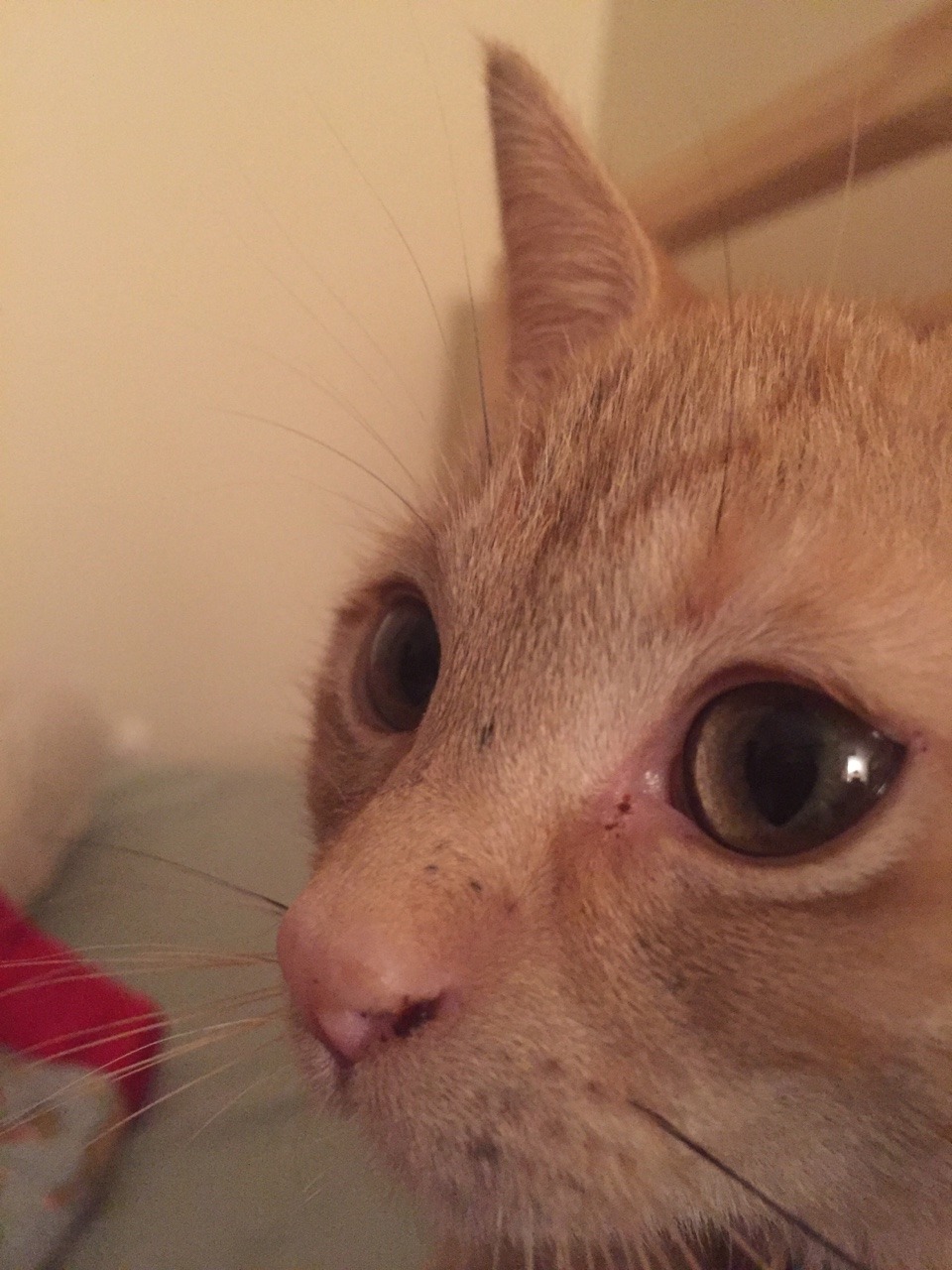
This morning I was lying in bed with the cats on either side of me, because they like watching me fiddle around on the phone. I lifted the phone up to the right to take a picture of Dearborn, and then I turned it around to take a picture of Polk, but before I could, Dearborn booped the phone with her nose and happened to hit the camera button.
So this is a photo of Polk the cat, taken by her sister Dearborn the also cat.
“On Friday morning, the president tweeted about the “phony stories of
sadness and grief” coming from the US-Mexico border – a clear attempt to
undermine media reports of traumatised undocumented immigrant families
separated by US officials.”
Motherfucker isn’t even human, I swear to god. I don’t mean this in the sense that ‘no human being could possibly be this callous’ because plenty of us are – I mean he’s cashed in his human card.
Bethany Christian Services, an adoption agency, has received 81 children from the border (one article states they are babies). Bethany says they are committed to reuniting families. Why were these babies transplanted from the Mexico border to Michigan? How did Bethany get involved? How do they plan on reuniting these babies? Why are these babies placed with a private adoption agency? Since WHEN has any adoption agency helped facilitate reunification and family preservation when their salaries LITERALLY rely on the fees collected by getting children for families who want them. Please answer Bethany Christian Services – THE WORLD IS WATCHING.
Call for Papers: What’s Jewish about death? – A Special Issue of SHOFAR: An Interdisciplinary Journal of Jewish Studies
Guest Editors: Laura Limonic, Assistant Professor of Sociology, SUNY Old Westbury; Tahneer Oksman, Assistant Professor of Academic Writing, Marymount Manhattan College
Journal Editors: Eugene Avrutin, University of Illinois; Ranen Omer-Sherman, University of Louisville
In her foreword to Jack Reimer’s foundational 1974 edited collection, Jewish Reflections on Death, a book that explores Jewish death and mourning through assorted lenses, Elisabeth Kubler-Ross inquires, “I have always wondered why the Jews as a people have not written more on death and dying. Who, better than they, could contribute to our understanding of the need to face the reality of our own finiteness?” Certainly, from the Kabbalah to dybbuks, from Sholem Aleichem to Roz Chast, there is no shortage of Jewish liturgical, mythological, literary, and cultural works incorporating related themes: of the boundaries between life and death; of the different approaches to philosophical, ethical, and religious questions pertaining to “the end”; and of ways of dealing with the practical and mundane matters that crop up around loss of life and its attendant issues. But the secondary literature on Jewish death and dying, i.e. historical, analytical, and comparative explorations of practices, rituals, beliefs, and narratives that span across Jewish landscapes, remains, as Kubler-Ross noted, surprisingly sparse. In this volume, we seek to put in conversation interdisciplinary investigations into whether, and if so how, contemporary Jews think and do death differently.
We are especially interested in cross-discursive explorations and are open to papers addressing the topic from a wide variety of viewpoints, including but not limited to:
fictional and non-fictional stories of death and grief (including poetry);
visual representations (art, photography, film, comics, collage, and/or graphic novels) of loss and its aftermaths;
variations within or across ethnic, sub-ethnic, and racial groups and/or different regions and populations in relation to death and grieving practices and beliefs;
material culture approaches to death and dying, including music, food, ceremony, clothing, etc.;
social and communal functions of traditional and/or contemporary death rituals, rites, and ceremonies;
connections and/or tensions between spiritual and/or traditional customs and observances and psychological or other models of grieving;
gender and/or sexuality in death and grief;
individual and communal trauma and attendant grief (genocide, suicide, etc.); and
death, grief, and the body.
We welcome two categories of works: (1) short narrative-style pieces in the forms of poetry, visual narratives, and creative non-fiction prose; and (2) more traditional analytic research articles (in this category, hybrid-pieces incorporating first-person prose or creative non-fiction alongside research and analysis are also welcome).
Deadline for 250-word abstracts (or illustrative excerpts): August 15, 2018. In your abstract, please indicate what category of work you are submitting, (1) or (2), and the target length of your final piece. Email submissions, including a short bio, to lauralimonic@gmail.com and toksman@mmm.edu.
Authors whose abstracts are accepted will be notified in early fall and asked to submit final pieces by March 1, 2019. There is no target length for the shorter narrative pieces (category 1), though authors should aim for 1,500-4,000 words of prose or 3-4 pages for visual narratives. For analytical research articles (category 2), manuscripts should be 7,000 to 10,000 words and conform to the latest Chicago Manual of Style, specifically, the short note format with a full bibliography (see examples below). Essays will be sent for review.
every time I see the words “Tolkien ripoff” in reference to fantasy I laugh, because while there’s a lot of Tolkien ripoff in worldbuilding it almost never crops up in plot or theme or characterization
like
where are my stories about the decay of the world from the glory of days gone by?
where’s the motif of limb loss?
where’s the longing for the return of something worth following?
where are the bloodthirsty oaths that tear sanity to shreds?
where are the evil spirits who try and destroy the gods with steampunk V-1 buzz bombs (looking at you, The Lost Road)?
where’s my continent-wide dialectical shift ending in massive arguments over the proper pronunciation of a name? where’s my family drama centered around sparkly rocks? where are my dragons the size of mountain ranges?
Tolkienesque Fantasy™: there’s a quest, the elves are bitchy, the dwarves drink a lot, farm boy hero.
Tolkien’s Actual Writing: absolute power corrupts absolutely, a little bit of power corrupts a little, to what extent are people responsible for their actions? does God/the gods really answer our prayers? and pacifistic undertones.
Also actual Tolkien: The world is full of hope even in dark times. Kindness and friendship are what heroes are made of. Absolutely do not fuck with nature or you will regret it.
Also actual Tolkien: actual heroes are little people who band together because it is right, and because they must.
Actual Tolkien: write your spouse into the story as an Actual Demigoddess whose song can charm even the Big Bad and the Keeper of the Dead themselves. Write your best friend into the story as a longwinded shaggy tree who takes hours to get to the fucking point.



 Mooncustafer