Everybody and their cousin has experienced the argument “is a tomato a fruit or a vegetable” at some point in their lives. It’s a fun bit of trivia, and let’s know-it-all’s speak condescendingly, or at least they did like 10 years ago. “Knowledge is knowing tomato is a fruit, wisdom is not putting it in a fruit salad”. Whatever.
Which brings up the point, that botany and culinary sciences are very different. Botany is the study of plants, culinary is cooking and how things taste. Botany is science, and it has rules (kind of), where cuisine is full of guidelines that are completely cultural.
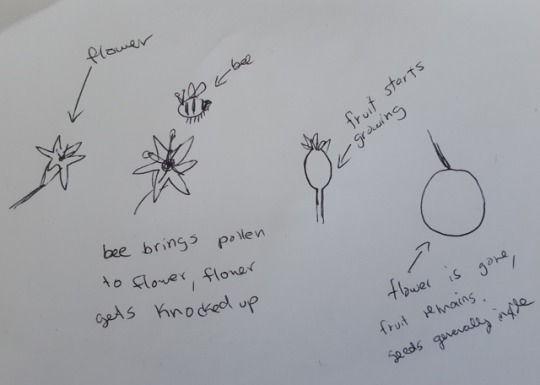
Tomatoes are a fruit. A fruit is how many plants have babies, and are made in the ovary of a flower. I have a diagram.
Armed with this knowledge we can know that tomatoes, cucumbers, squash, beans, peas and peppers are all fruit.
“Now”, I ask you, “what are lettuce, and cabbage, and spinach, and kale”?
“Vegetables”, you say, assuredly.
“Yes, but, what are they?”
“…vegetables”, you say, slower, and louder this time, not quite sure what I’m wanting from you.
No. They are leaves.
What are carrots, beets and radishes? Roots. What about celery and rhubarb? Stems. Potatoes? Tubers (food storage for the plant, and where new plant babies will grow from). Garlic and onions? Bulbs (also food storage). Mushrooms? They’re not even a plant, they’re a fungus, in the kingdom of fungi, which is somewhere between the plant and animal kingdoms.
“Vegetables” is just a word for plants that we eat, that doesn’t have enough sugar to be a fruit, and not enough flavour to be a herb or spice.
Botanically speaking, there is no such thing as a vegetable. They’re just different parts of a plant that happen to be edible.
There are other plants, normally considered weeds, that can be “eaten like a vegetable”. Dandelion, stinging nettle, dock, purslane, can all be cooked and eaten, making them vegetables, at least to the people to treat them as such. It’s all very cultural, and biased, and based on nothing but what people think it is. Therefore, they are not a real thing, it’s just a concept.
So I was watching an abbott & costello movie (”the time of their lives”) and there’s this character (played by Marjorie Reynolds) who dressed as a man during the revolutionary war so she could be a spy and then she gets shot and killed and comes back as a ghost and spends basically the ENTIRE movie dressed in this amazing outfit like some kind of lady Prince Eric and (THOSE DAMN BOOTS OMG) and I am living for it
I’ve only ever seen one Abbot and Costello movie (Abbot and
Costello Meet Frankenstein, 1948), but the female characters included a mad
scientist and an insurance investigator, and it passed the Bechdel test.
Edward Lovett’s curious collection of handmade charms and treasured trinkets reveal the hopes and fears of superstitious Londoners. At a meeting of the London Society held at the Royal Society of Arts on November 14, 1919, the president of the society, the artist Arthur Rackham, introduced the meeting’s lecturer as follows: “It is a very general habit to regard folklore as a thing of the past – something which concerns the historians. But is it not true that we ourselves are making history? We do not think of London as a country for folklore, and yet London is a very large country with peculiar boundaries; and also a country concerned with folklore. Ideas are constantly coming into London and constantly going out of it. As a real Londoner, I am very keen to hear what our speaker has to tell us about the folklore of London. I am quite sure he does not regard it as a dry science”. Rackham was right: the speaker at the meeting – Edward Lovett – certainly did not regard folklore and in particular, London’s folklore, as a “dry science”. His talk at the meeting – just like the numerous other pamphlets he wrote and lectures that he gave – explored his belief that in metropolitan Edwardian London thrived practices and beliefs more commonly associated with England’s rural past.
Given other folklorists of the period collected in rural England, why did Lovett pay particular attention to the capital? For him, the populations of the countryside who moved to the city took with them an array of beliefs which they still clung to when living in London. The objects Lovett collected in London illustrated customs which stemmed from all across Britain (and which he believed gave insight into customs practised long before his time).
Take, for instance, Lovett’s account from “northeast” London of a cow keeper, originally from Devonshire, who believed his cows to have died after being cursed. Seeking to find the culprit who had condemned his livestock, he took one of their hearts and stuck it all over with pins and nails in the belief that the pain inserted into the heart would trace itself back – and cause pain to – the person who placed the curse. This gruesome artefact is similar in construction to the ‘witch’s bottle’ which was found in Greenwich recently complete with finger nails and hair buried within it. While exploring London’s docks, Lovett spoke to sailors who cast pennies into the sea to “buy wind” on becalmed days, a practice he discovered that was also carried out on England’s east coast. In west London in 1914, the medical inspector of schools in Acton informed Lovett that children wore necklaces consisting of glass beads to ward off illness. The beads – “mostly blue, but occasionally yellow” – were worn underneath their clothes and believed to act as a charm against bronchitis. Their owners believed that the necklaces must never be taken off, even when washing. Lovett traversed London, finding over 60 shops were these beads were sold as amulets against illness, a journey depicted in a (self-drawn) map of London. Lovett’s relationship with the objects he collected was not a simple one. Even though his house in Caterham in Surrey was filled with his hoard of amulets and charms, he was no archetypal obsessive collector. In fact, Lovett’s relationship with his collection has more the air of the bank clerk balancing the books, with surviving correspondence suggesting someone skilled in selling items on in order to get the money to buy more, even keeping museums interested by passing selected items on to them over time.
To Lovett, a belief in the powers of amulets and charms would grow in times of crisis. Magic in Modern London includes numerous examples from the First World War, with British soldiers travelling to the Western Front with an array of good luck mascots and totems, including brooches in the shape of black cats and four-leaf clovers, and dominoes with ten dots. Lovett was an active collector as opposed to an armchair theorist, summing up his beliefs on the theories of urban folklore as follows: “I not only have no theory, but as regards my personal opinion as to the reason why these remarkable beliefs in magic still exist in modern London, I simply say ‘I don’t know’“.
But the amulets and charms Edward Lovett collected are not only testament to the spirit and interests of a keen folklorist, they capture something of the beliefs of everyday Londoners from a century ago. Whether worn to protect against illness, or kept to bring good luck, the objects he collected are miniature repositories for the hopes and fears of previous generations.
I’ve heard of the “pins stuck into the cursed item”
countercharm in a number of places – pins put into, say, one of your blasted
root vegetables, and the vegetable then boiled in a pot until the person who
placed the curse comes to your house. They will ask for some item of yours
three times; you must say no each time, and then the curse will rebound against
them. Once they have promised to stop bothering you, you can take the pot off
the boil and release them.
Every time someone tries to explain the metaplot of Supernatural to me, it basically ends up sounding like redneck Dragon Ball Z. I’m sure there’s some nuance I’m failing to grasp here.
Care to elaborate on that?
…I’m not even offended, just absolutely curious. From the stuff I’ve seen and heard about Supernatural I can’t see the connection.
Mostly, I get the impression of a show that doesn’t know how not to escalate.
Every threat’s gotta be quantitatively bigger and badder than the one that came before. Every deus ex machina’s gotta be shinier than the last one. Every season’s gotta end with a massive eleventh-hour powerup for our heroes, only for the next season to raise the stakes enough to put them back in the underdog position.
It’s like, you beat the Devil himself? Well, now you’ve gotta fight the Devil’s cousin Phil, who has conveniently gone entirely unmentioned up until now, but he’s totally twice as evil.
That last paragraph was literally supposed to be the most ridiculous hypothetical example I could think of, and people are messaging me to say “his name was Metatron, not Phil”. I can’t even make fun of this show.
How to tell if you may be Count Eric Stanislaus Stenbock, expatriate Estonian aristocrat, gay iconoclast, and hanger-on of the Decadent Movement:
If you are allowed to spend more than £400 a year your stepfather fears, based on his knowledge of your character, that you will easily become extravagant.
You have, as everyone knows, recently become a Roman Catholic. It is a very great grief to your mother and will cause sorrow to your entire family. You are however still young, and perhaps at Kolk, where there are very few priests, you may grow wiser as you get older, and again join some less ridiculous religion.
In order to escape your vast debts you spend the early 1880s living in dissipated poverty in Bruges, until receiving word that you have inherited the palatial family estates in Estonia. Thence you briefly retire with your pet monkey, snake, and “delightful tiny bear.”
Literally everyone who interacts with you remarks on your flaxen curls, your “childlike” and “inhuman” demeanor, and your outlandish taste in dinner-jacket fabrics.
You quickly abandon your Estonian palace to return to London and befriend Aubrey Beardsley, Alys Whittal Smith (future wife of Bertrand Russell), and Mary Costelloe (future mother-in-law of Virginia Woolf’s brother).
You travel everywhere with a life-sized wooden doll, whom you refer to as your son, “le petit compte.”
Your singular meeting with Oscar Wilde may or may not end with you collapsing on the floor with a bitter shriek after he gauchely lights his cigarette from the sacred lamp burning in your bedroom between your bust of Shelley and your ebony statue of the Buddha.
A year before your death, you relate to WB Yeats that you have been ordered by your doctor to eat nothing but bread and milk; yet he observes that you “drink limitless Champagne.”

 Mooncustafer