If one of every two straight white men were projected to become HIV positive, nothing else would be covered in the news. Ever. MSNBC, covering the pandemic 24/7, would rebrand itself MSHIV.
But, as only one in every 2,500 heterosexual white men are projected to become HIV positive – and as many white Americans imagine themselves immune to the kind of virus black gay and bisexual men would bring upon themselves – the black plague of HIV is not considered newsworthy.
Aids was a unifying force in gay politics from the early 1980s until the mid 1990s. Then, effective antiretroviral (ARV) drugs came to market that not only saved the lives of the millions of people who took them but – because ARVs can suppress HIV so effectively that virus levels become “undetectable” and thus “untransmittable” to others – they dramatically slowed rates of HIV transmission within certain communities.
However, these ARVs only helped the individual and communal bodies who got the drugs. And in the US, this largely meant that white gay men got the drugs early and often, while black gay America largely never got them. The inability to end HIV/Aids isn’t a failure of medicine, but a failure of racial capitalism.
Hence, as Aids deaths and rates of new HIV infections declined among white gay activists, many invested their social capital in fighting for causes such as marriage equality or “corporate equality” – positioning gay identity ever closer to middle-class ideals and imagining gay life as white, upwardly mobile, homonormative and HIV negative.
Over the same period, the epidemiology of HIV got worse in black America. But just as how the estimated 35 million people who have died of Aids, the 37 million people currently living with HIV, and the million people who still die from Aids every year globally are guilty of no moral failure, the half of black queer American men who are becoming HIV positive are not doing so due to particularly risky behaviour.
Indeed, black gay men have “fewer partners and lower rates of recreational drug use than other gay men”. It’s just that not enough of us got the drugs, and the things that structurally make people most at risk for HIV – homelessness, incarceration, and a lack of access to good education, employment and medical care – are experienced at high rates by black people.
Old Houses and Estates, Regardless of their Disrepair, are Much Akin to the Human Body, in the Measure that, as they grow Agéd and Weathered by Time, they are apt to groan, shake, creak, crack, and make a Great Deal of Noise, Particularly in the Morning and Evening, as I Readily attest. It is in All Probability not a Ghost which plagues you, but the House itself, in Combination with your Grief accompanying the Dreadful Loss of its Previous Owner. If you are Able at this Time to retreat from the Estate to a More Modern Abode while Repairs are Underway, I recommend it Highly; If you are Unable at this Juncture to leave the Place, then by All Means employ your Friend to assist you in the Rational Matter of auditing the House from Attic to Cellar, accounting for Each Room, Door, Fire-place, Window, and Chimney, for, though these Labyrinthine Manses are Rich Earth Only for Ghosts of our own Invention, they are Also Sprawling and Convoluted Enough that a Living Person, Perhaps a Determined Relative in Line for the Wealth you yourself have inherited, may hide and roam the Halls with Equanimity; Such a Person may be Present and conspiring to “spook” you out of your Wits–and Further, your Inheritance. A Similar Circumstance befell me as a Younger Man, when my Brother, God rest his Soul, attempted to shock me into deferring Unto him Possession of our Maiden Aunt’s Abbey. He did not succeed.
If, however, you are Absolutely Adamant that your Troubles are of Supernatural Origin, there are Certain Professional and Amateur Groups who may be called upon to assist you. I wish you Continued Good Health and Respite from these Trials, as Soon as they may be secured.
i’m not against vaping, but man, vaping two inches from my face on the subway is a ridiculous asshole kind of move. this dude was billowing like he was auditioning for the role of haunted house fog machine. the humidity in the whole car changed, he was ruining haircuts. just jump starting the water cycle. condensation was dripping down my glasses. people were slipping off poles, it was chaos. it was like watching one man try to terraform the moon. a planet with one dense, root beer scented atmosphere blocking out the sun and choking all life.
“To dream almost on tiptoe
because the resonance
of a dream, or of a hard foot
on such a tender ground
could demolish
the fabulous towers
of some Babylon.”
— Pedro Salinas, from “A Reason For Love”, translated from the Spanish by Ruth Katz Crispin
The Cambridge academic Robin Bunce said: “There is a fundamental danger of erasing the very notion of a struggle at all. I’ve been researching this for four and a half years and there have been so many occasions when people have said to me: ‘There was no black struggle in Britain. You’re thinking of South Africa or America.’“
The narrative that feeds it is the one that Britain is the utopia of fair play. We have such a commitment to individual rights, we have such a commitment to common sense and decency that there is no systematic racism in Britain.”…
Bunce said it was not just politicians, but wider British society that would rather not dwell on the less palatable.
Bringing this one back, while I’m reminded.
Important to remember; but also: “We are totally displeased
with our position” is the kind of thing people like to cite as “most British
protest sign”
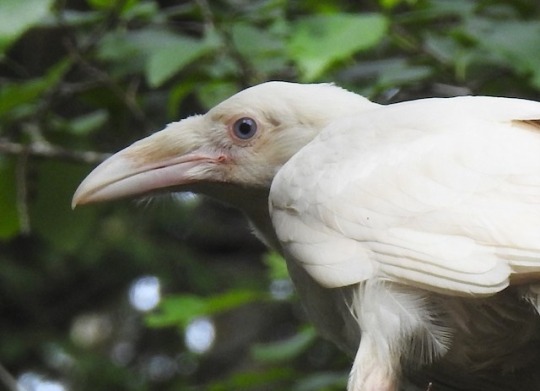
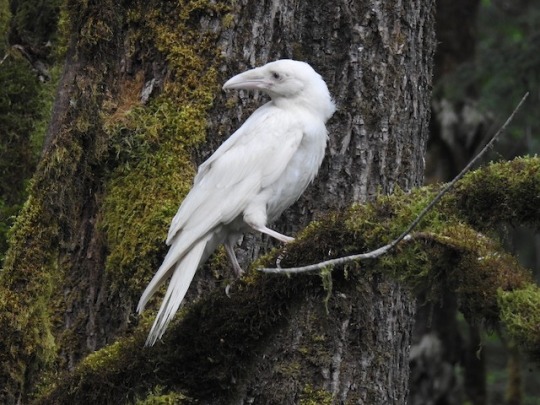
a common raven with leucism. leucism is similar to albinism, but is a partial lack of many pigments, not a complete loss. ravens are known for their black pigmentation; pure white birds like this one suffer from increased visibility to predators, as well as sometimes being rejected socially.
An excellent gentlebird and scholar, and one whom I would willingly friend!
I don’t think this bird isn’t leucistic, this is full albinism. Note the pale eyes, bill, and legs. Leucistic corvids tend to vary from various shades of cinnamon to piebald-like patches of white.
Here’s a great example of partial leucism in a crow that presents as ‘patches’ of white.
Pale eyes and pink gape are here a sign of this being a young animal, recently fledged. It was still begging parents, according to the photographer.
Textbook total leucism – lack of pigment on feathers, but beak, eyes, and feet are still pigmented.
I was DELIGHTED to see this potential correction in my notes, as it is an invitation to talk about a FAVORITE THING. I didn’t challenge the OP’s description myself as, to me, this is actually textbook leucism.
Albinism is the complete loss of melanin, so you’re either albino or you’re not, but leucism is considered to be a spectrum; in terms of melanin loss, it can be any decrease in melanin between albino and wild-type. So the instant that I saw this proposed correction, I took off my hat and threw it on the floor and shouted “I am READY to aRGUE that this bird is leucistic – just with higher degree of color loss than we may have expected to see. YEEHAW.” I was extremely excited and happy about the opportunity.
The reason I felt so confident is the blue shade of the eyes and the beige-y beak. Blue eyes are perfectly on-brand for leucistic animals, as blue eyes in animals (and humans) are caused by partial deposits of melanin; albinism is usually characterized by pink- or red-appearing eyes, because there is no cloud of melanin between the surface of the eye and the blood vessels behind it. If there is enough melanin to make a blue eye, then you can make the argument that the animal is leucistic.
I would also expect to see pink legs and beak rather than pale ones, like the OP bird has. Albinos also have a watery-pink sort of look around the eyes, which are generally not sparkling/bright, and I feel like there is a sort of raggedness about the feathers of an albino bird, probably due to the difficulty they have with poor vision.
Above is an albino magpie from an article in the Nautilus, with that sort of pinkish transparency and watery, ragged look I associate with a bird that has poor vision. With this visual comparison, I honestly would look at the bird in the OP and still call it leucistic, even though @birdsbugsandbones produces a good and compelling argument. (ETA, if it isn’t clear! I think they made a very VERY good argument and I definitely re-examined everything carefully and joyfully because of it! I am really happy to be talking about this! They make some great points!)
But let us never forget that Birdwatching People Are Mad with a Fulgent and Glittering Madness. So after throwing down my hat on a point of pedantry, I then proceeded to cheat by tapping into the rich seam of Birdwatching Madness that I expected lurked behind the photo in the OP. And boy, did it pay the FUCK off.
The source, the Macaulay Library, kindly tells us (after a lightyear of scrolling through entries for the Common Raven, Jesus Christ, Cornell, Pull Your Shit Together) that the two photos in the OP were taken by Cos van Wermeskerken on 6 Jul 2018, in Nanaimo, British Columbia, Canada. Thanks, Cornell!
However, within thirty miles of the excellently-documented sighting in the OP are the Qualicum White Ravens, which are very exciting to birders. Apparently this area of British Columbia is just CRAWLING with ‘white ravens,’ which are happily documented in the media because birdwatchers will literally cross the planet to shove a camera up the ass of a weird bird. And apparently they have a good chance of doing so on Vancouver Island.
This raven family – led by two normal black parents – appears to have produced off-colored offspring in this specific area for Years. They’re based around Qualicum Beach, and I remind you that the bird in the OP was spotted in Nanaimo.
That’s under 30 miles apart AS THE CROW FLIES! (Finger guns.) I would predict with some certainty that the bird in the OP photos is a member of this famous family.
“Jasper” was photographed in Courtenay. The parents of the white raven offspring are strongly associated with Qualicum Beach. Again, the bird in the OP was photographed in 2018 in Nanaimo. The sightings are clearly in a very specific area.
Despite what internet memes suggest, parent ravens do not eat their white offspring, said Kaeli Swift, a doctoral candidate at the University of Washington.
“They are often more subordinate, so they get picked on by other birds. But (the parents) don’t just take them out,” she said.
The Qualicum white ravens are not albinos — which have no pigment at all. Rather, they are the product of a genetic defect that dilutes their colour.
“You can also get all-white birds, but you can also get caramel-coloured birds, cappuccino colour, or crazy white stripes,” said Swift.
The Coombs bird likely has genetic anomalies that prevent the formation of two of the three types of melanin pigments, eumelanin and pheomelanin, according to Ildiko Szabo, a forensic ornithologist and curator at the Beaty Biodiversity Museum.
Most black birds have a mixture of those pigments — the Coombs bird probably has little of either.
“When that happens, it results in this extremely pale cafe au lait plumage,” Szabo said.
The “Coombs bird” they are referring to is a white raven that has been sighted around a farm near Qualicum Beach in July 2018:
Since these sightings of a pale-colored raven were in the same month, and about 20-something miles apart, in an area known for its white ravens, I would say that the Coombs bird is a relative of the OP bird, or perhaps even the same individual bird.
And it has been strongly and consistently argued that this specific bird, and the Qualicum white ravens generally, are leucistic and not albino.
So we must now decide if we can trust the word of Ildiko Szabo, forensic ornithologist and curator at the Beaty Biodiversity Museum, when she described the Coombs bird as probably having partial melanin deposits (and therefore not albino). Here is a video I found of her discussing the case of a single bird that flew from Asia to Canada (she is gesturing with the actual body of the bird here):
She looks like the type of person who could say ANYTHING about ANY bird, and I’d personally accept it. I would immediately give her my hat. She’s wearing a bird shirt and gesturing with a dead bird that she just stuffed, she’s a forensic ornithologist, she coauthored a 2018 paper in Nature on raven genetics. If she says a white raven spotted on Vancouver Island in July 2018 was probably leucistic, and she thinks it’s because it has less eumelanin and pheomelanin, then heck! Okay by me! If she wants to say it has “extremely pale cafe au lait plumage” rather than white, then sure! I’ll follow your lead on that, Ildiko!
Anyway, we could all be wrong, and whoever is right can GLADLY have The Hat. I’ve been raven on the topic long enough! But I’m happy to keep the OP raven in the Leucism Channel, where I will argue that it belongs.
@elodieunderglass Oh heck yes, what a reply! This is why I love running a science blog, chances are one post is someone out there’s Whole Deal and leap at the chance to share more info! Love that! I am delighted to be provided with more context and I’m stoked to see that the OP bird is kind of studied? That paper is so honkin’ interesting to boot. Corvid phylogenetics must be ridiculous.
Ildiko Szabo
is career goals in a nutshell, gosh, forensic ornithologist?! I didn’t even know that was a thing!
Suffice it to say my reply is: Birds and their many types of pigment, chemical and structural, are a nightmare when it comes to any kind of abundism or dilution, let alone partial expression. I will happily concede, given the info above, to the OP raven being an exceptionally strong example of leucism.
I will ad as a sidebar: “..I feel like there is a sort of raggedness about the feathers of an
albino bird, probably due to the difficulty they have with poor vision…” This might not actually be due to vision (which I think you might be implying might make them poor at preening? Please correct me if I’m wrong). There seems to be some evidence to support melanin being important not only as a visual component of feathers, but structural support! Thusly, feathers lacking melanins may be more fragile and wear easier than melanin-pigmented feathers. This is a pretty under-studied aspect of feather structure though, so jury is still out though. The overall physical structure of the feather might have more to do with it, at least according to Butler and Johnson. Their paper is a nice read on the subject, if you want something to add to your reading pile!
HEY:
I am in love with this post. It just keeps getting better.
@elodieunderglass, @birdsbugsandbones I can essentially confirm that melanin provides a structural component to bird feathers. My Ornithology professor, the late Jed Burtt, was studying how bacteria broke down bird feathers, and one of his discoveries was that birds in swamps had darker feathers which broke down slower due to bacteria. In addition, he also did studies on kittiwakes, and I think that’s where he found that their wingtips were black to help strengthen them (that, you can’t totally quote me on, because I didn’t get the chance to ask further, but I know he said that seabirds often have black wingtips to strengthen them as high-wear areas.) I should think you can find his publications on the subjects, but I don’t know where to start.
Thanks for the addition @silentsnowdrop! I had a look into the literature and found this article by him which is right on topic: “Colourful parrot feathers resist bacterial degradation”. Bonus, it’s open access! It seems your late professor did find some support for melanin contributing significantly to the structural integrity of the feather. I’m also thrilled to see that it affect bacterial breakdown! Even the bacteria find chunks of melanin hard to digest.





 Mooncustafer