Thousands of workers all over the world have been striking leading up to and on Prime Day, Amazon’s biggest sale, calling for better working conditions, pay and health benefits.
Nearly 1,800 Amazon workers (96% of the workers at the San Fernando warehouse) in Spain went on strike Monday during Prime Day, the company’s biggest sales day of the year
Thousands more Amazon employees in Germany are expected to walk off the job Tuesday, the second day of the sale in six warehouses.
Amazon’s website and mobile app crashed for about 45 minutes, due to a computer glitch – the most widespread to date, costing Amazon millions of dollars
In the US, advocacy groups are planning several consumer rallies outside Amazon-owned Whole Foods Market locations to protest the sale of Nazi, Confederate and white nationalist merchandise through Amazon’s marketplace of third-party sellers.
Amazon is still expected to profit more this year than last year. Let’s hope we can keep spreading the word about the boycott and prove them wrong. Spain’s strike is supposed to last through the 18th, so keep boycotting
The Tlingit are a native people who inhabit the southeastern coast of Alaska and Canada in the Pacific Northwest. An ingenious an resourceful people, the Tlingit were expert weapon and armor makers crafting wooden helmets and suits of armor made from animal skins woven with wooden slats. Originally the Tlingit had relatively advanced metallurgical skills, working tools in copper and rudimentary iron working. After European contact they quickly learned more advanced metallurgical skills such as advanced iron working and steel-making. Along with the neighboring Haida, the Tlingit were noted for crafting high quality iron and steel daggers. They even made swords in excess of 20 inches in blade length, being one of the few Native American cultures with a sword making tradition.
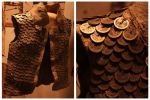
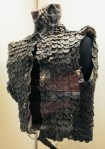
In the 18th century the Russians set up the Pacific Maritime Trade, a trading network in which Russian merchants would acquire furs from the Pacific Northwest and trade them for goods in China, which in turn could be traded in Europe and elsewhere. The Tlingit became active participants in this commercial enterprise, trading furs with the Russians for Chinese goods such as porcelain, silk, and tea. One item that particularly piqued their interest were Chinese coins. Made of bronze the coins typically had a hole in them so that they could be carried on a string that was attached to a sash or belt, since purses and moneybags were never popular in Chinese fashion. For the Chinese and Russians the coins were a form of currency, but for the Tlingit the coins had a entirely different purpose altogether. The Tlingit began sewing the coins onto animal hide vests crafting intricate suits of scale armor. The armor offered excellent protection against arrows, blades, and blunt weapons, and may have offered some modest protection against early firearms. Often these suits of armor were imbued with special mystical and magical properties, giving Tlingit warriors a psychological edge in combat.
In the 19th century British traders began to take up the trade, and finally Americans became dominant in the Pacific fur trade after Russia sold Alaska to the United States in 1867. Armor crafting from Chinese coins continued well into the late 19th century, being further bolstered by Chinese immigration to the west coast in the mid 1800s with the California gold rush. Today the Tlingit still produce beautiful knives, swords, and suits of armor, keeping alive a tradition which their forefathers had done before them.
I like how he comes back from the war and his family have just…. packed up and left. Like, did they say “quick, let’s get out of here before he comes back?!”
i’m mostly posting this as a reminder to myself, but i think other men struggling with body image or people who are dysphoric about their hips can benefit from seeing this too.
this is part of a body positivity campaign launched by clothing company dressman called #justthewayyouare and if you click that link there’s more body types being represented in their ads.
i have never seen any body positivity for men like this before, marketing ploy or not it DOES help me seeing my body type (wide hips and chub and all) being represented in a public space like this, especially with the word “perfect” attached to it.
i’ve came back to this picture for a while now as a reminder that my body is a valid body, and i hope it will help someone else too.













 Mooncustafer